Category Archives: Amateur Radio

Radio activity from Chile

As some of you might be aware, I’m going travelling in Chile for most of November and December. This isn’t a radio DXpedition as I can only take one 23kg suitcase to last 6 weeks and clothes and camping stuff have to take priority!

That said, I do have a Chilean licence, and I am taking some equipment, so this is the plan at time of writing:

Callsign

As I am travelling and don’t have a particular base in the country, the Radio Club de Chile have kindly suggested I use their HQ address in Santiago (CE3) as my licence address. This means that my Chilean licence has been issued as CE3/M0BLF

As I understand the Chilean rules, when I am operating from other parts of Chile, I have to use the local area number as a suffix to the Santiago callsign, eg. CE3/M0BLF/6

HF

I’m taking my IC-706 and a 15m dipole. There won’t be any linear and power will be from a Gel Cell (Sealed Lead Acid battery), which I’ll buy out there to carry on the part of my journey through Patagonia from Temuco – Tierra del Fuego (19th November – 11th December, if all goes to plan). Due to the fact that I can’t take such batteries on planes, I won’t be using the HF gear from other places in the country.

I expect most activity to be CW / PSK31 to reduce power demands. I may also send back a couple photos via SSTV, just because I can. When I’m further south, away from where most people are beaming, I’ll aim to appear on WSPR for a little while before I switch to CW. WSPR allows me to announce I’m there without requiring a full-power CQ call that would be needed to reach the RBN.

Activity will only be occasional, from campsites, and I may not be able to get the antenna up high as I don’t have luggage space for poles, etc.

CQ WW CW

The biggest CW contest of the year takes place while I’m in Chile. I plan to operate as much as the batteries will permit as CE3/M0BLF/6 from the Puyehue region in central Chile. This will be Single Band on 15m. I’ll decide out there whether to enter Low Power or QRP.

IOTA Activations

Assuming I stick to my itinerary, I should also be active from:

  • Chiloe (SA-018) on 30th November and 1st December as CE3/M0BLF/7
  • Tierra del Fuego (SA-008) on 10th December as CE3/M0BLF/8

Again, this will be low-power, battery-operated, single-band, so please don’t expect too much! For the same reason, I will not arrange skeds.

Yes, I will be passing lots of rare island groups as I sail down through Patagonia between Puerto Montt and Puerto Natales, but I’ll be on a ferry and I won’t be able to disembark. Another time, perhaps.

APRS/Echolink

  • I’ll be active on APRS as M0BLF-7 in areas with APRS coverage, but be aware that coverage in the country isn’t very great
  • I’ll be taking an Iridium tracker (thanks M0VFC) which cross-posts positions to APRS as M0BLF-12
  • I hope to use some of the local 2m Echolink nodes to contact people at home

Updated 5-Nov-15: Switched band to 15m in the light of the latest propagation predictions; mentioned the WSPR beacon.

That’s all folks…

That’s it. At 01:30 UTC on 17th July, we finished our DXpedition to Svalbard. So, how did we do?

The raw numbers

On the face of it, this wasn’t our most successful DXpedition in terms of QSO count. During the six full days we were QRV, we only made 6305 contacts between the six of us.

That hides a significant fact, however: this far north we never really expected to make a huge number of contacts. I’ve written more about propagation below, but to summarise only 30m, 20m and 17m were really open.

We had decided before we came to split into two groups, therefore: On Sunday, M0VFC, M1ACB and myself went on an excursion to Barentsberg allowing G3ZAY, M0HSW and M0TJH to stay in the shack. We did the opposite on Monday. Then, on Tuesday and Wednesday, we adopted the same pattern for our excursion to Pyramiden. This means that for most of the time, there were only three people in the shack.

Perhaps more surprising for us was the 44:56% SSB:CW (2858:3447) split. As it happened G3ZAY, M0VFC and I made almost exclusively CW QSOs, leaving M1ACB, M0HSW and M0TJH to do almost all the voice operation. That wasn’t planned as such, but worked well from our point-of-view.

Propagation

Propagation in Svalbard in the summer is weird. First of all, there is no nighttime during the months of Midnight Sun, so nothing below 30m ever really works. We made just 29 QSOs on 40m, and none on anything lower.

30m had some good openings during morning and evening but was pretty dead during the main part of the day. Throughout what would be the ‘night’, there was often good propagation to the US, which we could see from the 30m APRS beacon we operated.   965 (15%) contacts were on 30m.

20m was the most reliable band and was often open to JA, EU and NA at the same time. Even it went through a quiet period from mid-morning until mid-afternoon however. 3534 (56%) contacts were on 20m.

17m was often open during the afternoon to JA and NA, and then EU in the early evening. There was almost nothing here during the mornings. 1772 (28%) contacts were on 17m.

15m and higher were pretty much constantly dead. We made just 5 CW QSOs on 15m.

Overall, however, the main thing we noticed was that propagation was hugely susceptible to the K-Index. At a K of 5, most bands were pretty unusable. On days when K went down to 2, we made many more contacts, except for our final day which seemed to buck that trend. It might be that flux collapsing to 100 was responsible for that.

Logging

We were logging with Win-Test. With six operators using their own callsigns, you might have assumed we had six laptops but with only three stations we didn’t do that. We instead adopted the approach we’d used successfully in VP9: all copies of Win-Test were networked together and we all logged into a single log. We ‘logged in’ to Win-Test for each of our shifts, however, so we could then separate the logs based on the operator callsign.

During the latter part of the trip, we were uploading logs automatically every 30 minutes to Clublog and LotW. We’ll blog more about how this was done later (and I think a presentation for the RSGB Convention is planned), but basically we had a program listening to Win-Test’s network, capturing the QSOs, compressing them, and then batching them up.

APRS

We always like to innovate in some way on our DXpeditions, and this year (in addition to the live uploads), we also experimented with running an APRS beacon using MFSK16 on 30m. This was less successful than we had hoped given propagation on that band, but it was useful in that I could check how open 30m was to the States when I woke up. I could have used WSPR for the same result, though, assuming internet connection.

That’s kind of the point, though: had we not had internet access (which we weren’t expecting to have), APRS could have given us a route to do basic messaging if required. I think it’s something we will continue playing with to see whether the technology can bring anything extra to DXpeditions.

Thanks to members of the Cross Country Wireless email reflector for running IGates for our packets, and especially to Chris G4HYG for writing APRS Messenger, which we used for the beacon.

And finally…

Photos

My photos from the trip are in a set on Flickr.

Aerial photography

Hugo, M0HSW, brought a drone with him as his hand-luggage. We might have ridiculed him at the airport a little bit, but the film of aerial shots of Svalbard (Longyearbyen and Pyramiden) that he has produced is spectacular. Viewing it is highly recommended:


Staying at JW5E

While we’re in Svalbard, we’re operating from the JW5E shack, the local radio club cabin. I’m also sleeping here, so I thought I’d give a quick introduction to what’ it’s like to stay at the station, which can be rented by other radio amateurs. For official information on the station, see jw5e.com

Before going any further, I should stress that this post is intended only as a factual description of the shack at time of writing, in an attempt to help future visitors with some of the stuff we hadn’t known. This isn’t to criticise – the local amateurs have been wonderfully welcoming, and their willingness to open the station to others is very much appreciated.

Location

The shack is located on the shore of the fjord, just east of the main centre of Longyearbyen, but within easy walking distance of the main shopping street and the hotels in town.

Polar bears have been known to come up the fjord, so there is a slight risk, but the shack is within the ‘no polar bear protection needed’ area of town. There’s a can of CS gas by the door in case of an unexpected visitor, but we’re told it would be technically illegal to use this (on the safety grounds that you’d be likely to spray yourself while panicking!).

There’s good mobile phone coverage in Longyearbyen from both Telenor and NetCom. Although our mobile operators in the UK claimed they didn’t have roaming agreements with Svalbard, in practice it seems that if your operator has an agreement with the Norwegian operators listed above, roaming works. For Three UK customers, it looks as though this means Svalbard comes under the Feel At Home deal for Norway; I’ll update this information if we get an unexpectedly large phone bill on our return!

Credit cards are widely accepted. I’d always carry some cash but we haven’t needed very much. On the whole, goods are quite expensive because of the cost of importing them to such a remote location.

JW5E

Facilities

Living space

The cabin has kitchen with fridge, kettle, coffee machine and microwave, 2 bunk beds, sofas and a toilet. There’s heating (and in fact the shack has been at times too warm at night, at about 20c) but there’s no running water here. You can buy bottles of water in the amply-stocked supermarket, and we’ve also been filling bottles at the hotel where some of the other operators are staying.

The toilet is a combustion toilet ‘for solid matter only’ (liquid deposits are left on the beach outside), which is easy to operate. It seems you have to guess whether you need a 40 minute or 70 minute burn for the size of the job, however! I’d recommend bringing some alcohol hand gel as there’s no water to wash your hands.

The beds are comfortable, although right now someone using the upper bunk would have to share it with a Butternut vertical! Just bring a sleeping bag and you’re good to go.

Shack

The shack currently comes equipped with a FT-1000MP Mark V and TS-870, with an interlocked six-pack antenna switch at each of the two operating positions. We’ve actually crammed four operating positions into the space and put the TS-870 to one side so we can fit the two K3s and IC-706Mk2G we brought with us. The FT-1000MP Mark V station has a MicroHam unit and computer. Each operating position has a 20A power supply.

The shack used to have an amplifer but this has now been removed due to repeated damage by visiting groups, which is a pity but understandable. We’ve got a KPA500 with us. On the other hand, the shack now has Wifi, which was a nice surprise. This is supplied from Martin JW5ZLA’s home connection, via a Ubiquiti link on the tower.

The shack also has a range of useful accessories, patch cables, etc neatly arranged on shelves. There’s also a limited supply of tools but as always, it’s probably safest to bring your own accessories! Power, by the way, is 220V 50Hz with European plugs.

If you’ve seen W2NAF’s video of the shack, there has been some renovation work since it was filmed, so the orientation is now the other way around:

JW5E shack

Antennas

The state of antennas at the shack is a bit ropey, so you may want to bring plenty of wire and fibreglass poles. A climbing harness for the tower may also come in useful. We’ve installed a vertical dipole for 20m on the beach outside the shack for our operation.

As of today, JW5E has:

  • 10m / 12m beam
    We haven’t used this as the bands haven’t been open. It’s very close vertically to the 15/17/20 Optibeam, however, so it may not be in tune.
  • 15 / 17 / 20m Optibeam
    This is missing a director and is rather close to the 10/12m beam. SWR is OK on 17m but it is high on 15m (about 2:1) and very high on 20m (about 3:1 at the CW end and 2:1 at the SSB end). We’re using it as a 17m single band beam.
  • 30m dipole
    This is working OK.
  • 40m sloper
    Needs an ATU on 40m but works fine with a good SWR on 15m.
  • 80m dipole
    We haven’t used this as the band isn’t open during the 24h sunlight in the summer.
  • 6m beam (fixed pointing South)
    The reflector is badly bent and the coax doesn’t enter the shack.
    We’ve now bent the reflector back since the photo below.
  • 6 – 40m vertical
    We’ve used this a bit on 40m but generally the sloper seems better. We haven’t used it on other bands as we noticed that RF gets into the shack (it’s literally just outside the window).
  • 2m and 70cms verticals
    We haven’t tested these.

The HF beams are on a ProSisTel rotator in the shack.

JW5E antennas

Amateur radio on Spitsbergen

There is a 2m repeater, JW9SRR, on a mountain out of town, which can be reached from a handheld outside in Longyearbyen. We’re told it’s not completely reliable at the moment but it seemed to open when we tested it. It’s on 145.600 with a -600Hz shift, 91.5Hz CTCSS.

There’s also an APRS node on the European APRS frequency (144.8MHz) and there are simplex frequencies on the VHF bands used by the locals, which are listed in the shack.

An excursion to Pyramiden

After our trip to Barentsberg a couple days previously, yesterday we went to Pyramiden, named after the Pyramid-shaped mountain above the town. Like Barentsberg, this is a Russian coal-mining settlement. Unlike Barentsberg, however, Pyramiden is a ghost town.

Or almost a ghost town. The mine closed in 1997. Under the Svalbard Treaty, if a settlement is abandoned for 10 years, the country responsible has to remove all trace of the town and return the area to its natural state. In early 2007 – 9 years and 10 months after the town had been abandoned – the Russian government decided it was cheaper to pay for 2 people to stay there, repairing buildings, than removing all trace of a town for over 1000 people and the associated mine. Today, the population has increased to 8. They get all their supplies from Barentsberg and, apart from one square metre on the harbour where there’s mobile telephone coverage from Longyearbyen, the only communication is by letter twice a month or satellite phone for emergencies.

Nevertheless, to all intents and purposes, this is a ghost town, and a fascinating relic of a remote outpost of the Soviet Union. Recent polar bear visits to the town meant that we weren’t free to explore; we had to travel as a group with our guide, rifle in hand, just in case.

Even the 'r' of the town's name 'Pyramiden' is missing on this sign.
Even the ‘r’ of the town’s name ‘Pyramiden’ is missing on this sign.

Pyramiden town

A child's painting in Pyramiden cultural centre
A child’s painting in Pyramiden cultural centre
Film abandoned on the floor in the Cultural Centre, which was also the town's cinema.
Film abandoned on the floor in the Cultural Centre, which was also the town’s cinema.
The main street on Pyramiden, called '60th Anniversary of the October Revolution Street', looking towards the Cultural Centre and statue of Lenin.
The main street in Pyramiden, called ’60th Anniversary of the October Revolution Street’, looking towards the Cultural Centre and statue of Lenin.
Our boat's route to Pyramiden. Again, the track that appears to be on land is because the glacier has receded, so the map is out-of-date.
Our boat’s route to Pyramiden. Again, the track that appears to be on land is because the glacier has receded, so the map is out-of-date.

For anyone wishing to do this trip themselves, this excursion was organised by Spitsbergen Travel and comes highly recommended. The guides are excellent. If you’re wondering whether to do both Barentsberg and Pyramiden, I’d say emphatically, yes. The towns might both be Russian, but that’s where the similarities end. I found Pyramiden felt more comfortable as its ghost town nature is explicable with the collapse of mining after the fall of the USSR, unlike Barentsberg which just feels out of place.

An excursion to Barentsberg

Yesterday, Rob M0VFC, Steve M1ACB and I left the rest of the group in the shack while we took a trip to the Russian settlement of Barentsberg here on Svalbard.

The excursion was organised by Svalbard Travel and is moderately expensive, but well worth the cost for a long day on a boat with an excellent guide. The only disappointment was the fog that plagued us most of the way to Barentsberg.

The trip starts with a detour to the Esmark glacier, where we were given barbecued whale on the deck for lunch. I’m not insensitive to the controversy surrounding eating whale but when in Rome… I’d never had it before, and it’s unlikely I will have it again as the meat was rather tasteless other than the chilli marinade it had been kept in.

Esmark GlacierAfter this spectacular detour (where we even got to see some of the ice breaking off), the ship turned South across the fjord to Barentsberg, where — after a minor issue in which our boat got entangled in another boat’s mooring lines — our guide handed over to a Russian guide for the tour of the town.

Like most places on Svalbard, Barentsberg was established as a coal mining town and was Russian-controlled for almost all of the 20th century (and it still is). There’s something distinctly not quite right about the place, however. Most of the town has seen better days. The buildings are rotting and collapsing and little effort is being made to preserve them as nature takes over. A broken child’s swing gave me echoes of the photos you see of Pripyat near Chernobyl.

Barentsberg

In the main square, the guide was keen to point out the statue of Lenin and the sign proclaiming ‘Our goal: Communism’, saying that of course their goal no longer is Communism and that the banner today only reflects an important part in Russia’s recent history. She then went on to explain how the workers are provided housing in large accommodation blocks, there’s a subsidized canteen, and only two shops in the town – one for food and the other for everything else. They operate a cashless society, with credit being stored on cards with which everyone is issued. Contracts for the mining workers are for a fixed 2 years, after which they are allowed to go home for 2 months. I’ll leave the reader to consider the implications of the preceding sentences, but suffice it to say, the place felt like a timewarp. We were also told about the Russian consulate in Barentsberg being the most northerly in the world, with the great acclaim from our guide ‘It’s Russian, and it’s here’.

Lenin outside the worker's accommodation
Statue of Lenin outside the worker’s accommodation. The banner reads ‘Our goal: Communism’

Perhaps the strangest thing about the town, however, is the size of some of the facilities. The current population is just 400 and yet the school (for 40 pupils) and newly-built hospital are clearly designed for many, many more than just the current number of miners and their families.

The school for 40 pupils. The artwork was done a few years ago by students at the St Petersberg School of Arts.
Our tour's route from Longyearbyen to Esford to Barentsberg and back to Longyearbyen. The position that suggests we were on land near Grumant is incorrect - it's the map that's wrong not the position!
Our tour’s route from Longyearbyen to Esford to Barentsberg and back to Longyearbyen. The position that suggests we were on land near Grumant is incorrect – it’s the map that’s wrong not the position!


Hello from Svalbard

After two flights (London – Oslo, then Oslo – Longyearbyen), we’ve arrived in Svalbard. This is the view from the shack, taken just after we arrived (about 00:30 local time). The midnight sun is very real!

View from the shack on Svalbard

The first surprise, we have mobile phone signals and the shack has internet. So, our fears about lack of connectivity were slightly misplaced. Nevertheless, we’re still going to be uploading logs via the Iridium satellite link, and we’ll be doing APRS over HF, because we can.

The JW5E shack has been slightly reconfigured since the video W2NAF took last year but some of the antennas no longer work efficiently. As I type, this is the current situation (which may change over the week):

  • We’ve installed a new 30m dipole. Rob M0VFC is on 30m CW with the shack’s FT-1000MP Mark 5.
  • Steve M1ACB is using the 40-6m vertical to operate 17m SSB with his Elecraft K3.
  • Hugo M0HSW is on 20m using the 15/17/20m beam using Rob’s K3 and a KPA500.
  • My IC-706 is set up as the data station for later on. It will use any antennas that are free.

We’ll be on during the IARU contest – we’ll be giving reports but we aren’t entering: with so few bands open this far North and multiple callsigns between us, we wouldn’t be able to be competitive.

M0HSW, M1ACB and M0VFC operating in Svalbard

DXpedition Announcement: Svalbard, July 2015

From 10th-17th July 2015, I will be one of six operators activating the JW5E shack on Svalbard.

We’ll be operating on 40m-10m (and maybe some 6m if conditions allow), mainly on SSB and CW, using JW/{homecall}.

We won’t arrive in Longyearbyen until late in the evening of Friday 10th, and we depart very early in the morning on Friday 17th, so in practice we’ll be QRV for about six days.

Please remember that Svalbard has midnight sun for about four months, so it won’t get dark while we’re there. That means that we’re expecting 40m and 15m+ to be very difficult.

QSL will be via Clublog OQRS (please don’t send paper cards). We will be swapping operator at times, so please ensure you log the correct home call – don’t rely on an old spot from the cluster.

For more information, see my main DXpedition page at http://www.domsmith.co.uk/amateur-radio/dxpeditions/2015/jw

The full operator list is:

  • Myself
  • Martin G3ZAY
  • Hugo M0HSW
  • Tom M0TJH
  • Rob M0VFC
  • Gavin M1BXF

Response to the RSGB Contest Committee’s whitepaper – May 2014

On 26th May 2014, the RSGB Contest Committee announced a Whitepaper containing proposals and suggestions for various rule changes. [Whitepaper]

I really welcome this development. It’s great to see the Contest Committee so engaged and keen to hear feedback, and also I like having a clear timetable for the decision-making process based on this feedback.

It was subsequently suggested on the uk-vhf-contesting reflector that it would be interesting to discuss some of the options, and for that reason I’m publishing my response below.

My feedback on Rule Change Proposal Whitepaper

VP9/M0BLF: Log analysis

LogAnalysisOne of the things I like to do shortly after a DXpedition is to do some fairly detailed statistical analysis on my log. This helps highlight openings or areas of the world I might have missed, and helps me consider improvements for the next trip. It can also help identify where propagation predictions did, and didn’t, match reality.

This time, I’ve decided to share my analysis here.

Over the week, between four of us operating fairly leisurely, we made just under 16,000 QSOs, of which I made 3320.

Mode and band choice

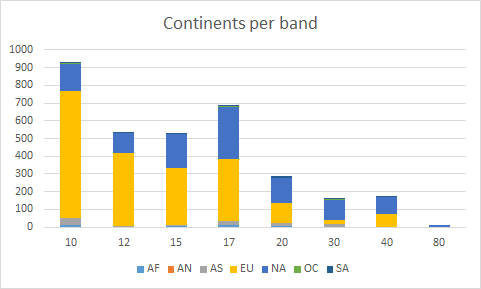
As a team, we’d decided before the DXpedition to focus on the WARC bands, because VP9 is often activated in contests. Due to the 150W limit in VP9, most of the others had also decided to concentrate on CW, but I wanted to maintain about a 50:50 balance of CW and SSB.

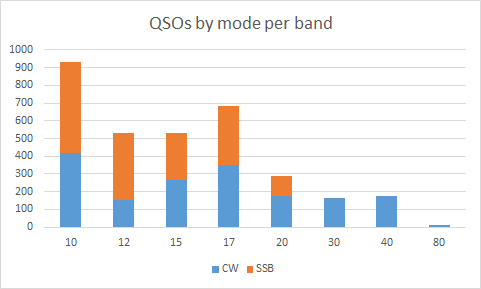
As indicated in the graph below, I broadly achieved that balance on the higher bands, but conditions just didn’t permit CW on 40m and 80m. Moreover, with the higher bands performing so well, I was able to take advantage of the conditions on 10m and 15m, even though that meant slightly less WARC activity than I had planned.

image

Rates

VP9 is also not a rare DXCC, so we weren’t aiming for particularly high rates on this trip. We’d wanted to have the opportunity to do plenty of tourism while we were there, too, so we were expecting to have some days with less activity than others. Luckily, we also knew that propagation around midday could be difficult on several bands, so this would give us the opportunity to go out and see more of the island.

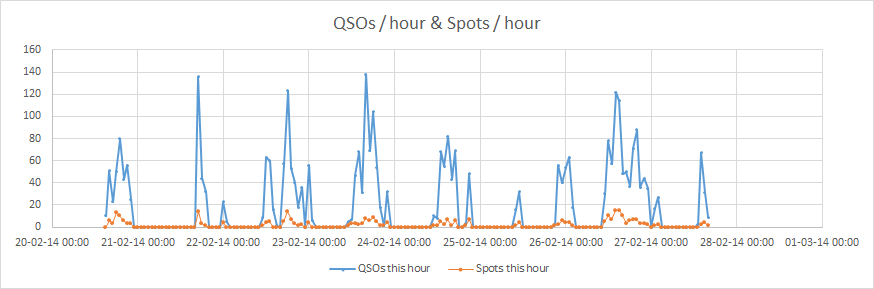
The graph of QSOs / hour reflects this, but I still managed to approach 140 contacts per hour a couple of times, despite this relaxed operation.

It is also interesting that the number of spots per hour roughly tracks the number of QSOs I was making (I‘m not sure whether this is cause or effect; I suspect a bit of both)

image

Perhaps more notable is the rate that was achievable on each band. 12m was far the most open band in these terms, which is rather a surprise, particularly when compared to 10m. Obviously the idea of concentrating on WARC bands wasn’t a bad idea. (This graph is slightly misleading in that it doesn’t take into account when I was operating and on several occasions my role was to make the last few QSOs as the band closed, while the others operated on more productive wavelengths.)

image

Geographic spread

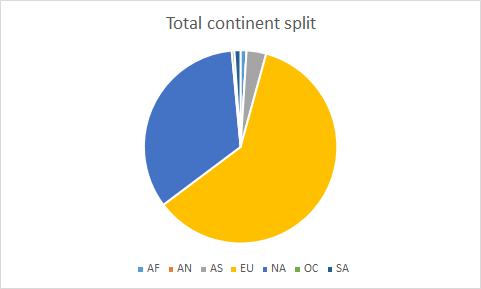
I’m rather surprised to see how skewed towards Europe my log is; it certainly felt as though I was making many more contacts to North America. It’s pleasing that there is a small number of Asian stations in there too, however. This was mainly contributed by some reasonable runs into Japan on a slightly difficult auroral greyline path over the Arctic.

image

This data becomes more interesting when analysed per band, however. Whilst Europe dominated on 10m and 12m, the Europe : North America balance was more even from 17m downwards (and, indeed, North America was the source of a majority of my QSOs in 30m).

The lack of Asian stations on 12m is mainly because Martin G3ZAY operated on that band during the greyline openings.

image

I’m slightly surprised there aren’t more African stations in the log. It should have been an easy path but we just didn’t have many callers from there.

The top 20 DXCCs to call me were more-or-less as expected but, being patriotic, it’s great to see so G (England) so high in the list:

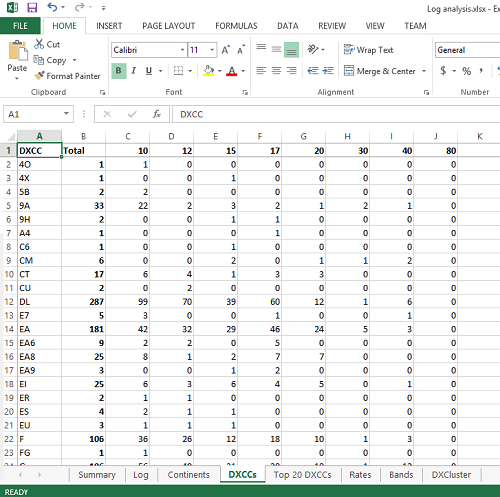
DXCC

Total QSOs

% QSOs

K 987 30%
DL 287 9%
I 284 9%
G 196 6%
EA 181 5%
SP 136 4%
F 106 3%
UA 101 3%
VE 101 3%
JA 88 3%
UR 73 2%
PA 66 2%
ON 61 2%
OK 60 2%
SM 41 1%
S5 36 1%
9A 33 1%
OM 33 1%
OE 26 1%
OH 26 1%

Anything else?

Is there anything else you’d like to learn from my log? If so, feel free to add a comment. For those who are interested, this is simply a CSV export from Win-Test into Excel, so I can easily analyse any other factors Win-Test can export.

Planning, Prattling and Parting: Calling a DX station

M0BLF operatingAs many of you will be aware, I’ve recently returned from operating as VP9/M0BLF in Bermuda.

Overall, it was a great trip but it was marred on a few occasions by some discourteous and unruly operation by a small proportion of the DXing community. A lot has already been written about pile-up behaviour but I thought I’d add my two cents from the point-of-view of the DX station. As I considered the topic, however, I realised this is basically about following some simple rules. At the risk of this sounding like a bit of a rant, therefore, here are my thoughts.

First, though, I should note that a lot of this post is focused on CW operating. That’s because my CW is weaker than my SSB, and so the problems become magnified. Generally, however, the rules are the same for any mode. I should also note that this post isn’t an excuse for my (at times) poor CW operation. It’s something I need to practice. But you, the pile-up, could make my life a lot easier while I improve my skills.

1. Planning

Before you pick up the CW key or microphone, there are two golden rules:

a) Ensure you can hear me

I don’t care whether I’m DX for you or not, or whether you need the QSO for DXCC or another award programme. If you can’t hear me, we won’t be able to have a contact. It’s that simple.

Generally, I’ll be operating split, so you should be able to hear me on my calling frequency. If policemen are getting in the way such that you won’t hear me replying, don’t call me. If there’s deep QSB, listen and learn the time between the peak and the trough, and call me around the peak only. You really slow my ability to work the whole pile-up if you call when you can’t hear me.

b) Know your callsign and how to send it

This should be obvious, but a few too many callers had to resend their callsign because they put the wrong letters in it. Similarly, and this mainly applies to people using straight keys, check you can send your callsign reliably a few times without corrupting it, maintaining the right rhythm and a 3:1 dash:dot length ratio. If you can’t do this basic thing, don’t call me. If you’re new to CW, consider programming your callsign – once – into a CW keyer memory. I’d rather have computer/keyer-generated perfectly-sent CW than errors.

Also, I’d prefer you only to send your callsign once unless I ask for you by a part of your callsign, but I know that’s not always going to happen. If you do repeat your callsign, make sure the gap is clear with a suitable break. If I hear ‘M0BLFM0BLF’, that’s likely to confuse me, particularly if I only hear part of it.

Only after you’re certain you can hear me and you can send your callsign should you actually call me.

Oh, and don’t tune up on top of the pile-up while you’re at it…

2. Prattling

a) What to exchange

Always send at my speed. I was doing 20wpm in VP9. I can receive well-sent Morse at up to around 23wpm reliably. This means that if you transmit at 35wpm, you’ll have to repeat yourself several times, which will frustrate both of us.

If I ask for you to call me by a partial callsign, everyone except the person with that partial should stop calling. If you have a callsign that’s similar to what I’ve asked for, give it a few seconds (to allow anyone with the exact match to reply first) and then call me once. Above all, make sure you know whom I’ve gone back to: two people won’t be getting VP9 confirmations because I went back to someone different.

If I ask you to repeat your call several times, don’t be condescending by slowing down or, worse, making dashes longer. It’s probably just someone calling on top of you but changing your speed makes me have to concentrate more, not less.

Unless it’s fairly quiet, I want to give as many people as possible the opportunity to call me, so I only want to hear your callsign and my report. If I’m happy to have a chat, I’ll indicate this by telling you my name and making some trivial remark like something about the weather. Let me, as the DX station, guide you on this.

If you haven’t had that cue from me, please do not ask me anything else, or give me other information. I’m highly unlikely to ask your name, let alone log it. Additional information can also be actively confusing. For example, a lot of US stations have the habit of giving their US state abbreviation after the RST report. I don’t need to know this and, if it is similar to your callsign, it could lead me to correct something unnecessarily. (If you call me as W0ABC and then send me state code AB twice, I may well ‘correct’ your callsign to W0AB).

Above all, don’t ask for QSL information. It’s widely published, and it’s probably quicker for you to look at QRZ.com or similar. And don’t ask for my ‘callsign again slowly’, especially if I’m mid-pileup. It will be on the cluster and/or RBN, and I’ll be saying it at least every 3 QSOs too. As far as I’m concerned, if you haven’t got my callsign, that’s your problem, not mine, and you should know it before you call me (don’t trust what the cluster says, either).

b) Operating split

Split operation can have two objectives:

  1. To ensure you can hear me reply to the pile-up, even if people are still calling
  2. To let me spread the pileup over a range of frequencies to be able to pick someone out better

In a smaller pileup, only the first reason above applies. In these cases, I’ll generally be saying ‘UP1’ on CW (for a 1kHz split) or ‘Up Five’ on SSB (for a 5kHz split). If you hear this, use that split only. If you go up 4kHz when I’ve said ‘Up Five’, I’m unlikely to ever find you.

On CW, however, you should add or subtract a slight offset of up to 200Hz so you don’t all end up with exactly the same beat frequency. This is particularly important if you’ve just clicked on a DX Cluster spot with a QSX frequency set in it. If you don’t move at all, you will have exactly the same note as everyone else and I won’t be able to distinguish any of you. It’s amazing how many people don’t seem to realise this.

In a larger pileup, both of the reasons above apply. In these cases, I’ll generally be saying ‘UP’ on CW (which you should interpret as being about a 1kHz – 2.5kHz range) and ‘Up Five to Eight’ on SSB (a 5kHz-8kHz range).

In this scenario, I really want you to spread out. Don’t all congregate on round-number frequencies and, again, if you have clicked a spot with a QSX frequency, you almost certainly want to change your split from the one in the spot so you stand out.

I’ll typically be operating according to a pattern in this scenario. For example, I might start at the top of the range, make a couple QSOs, then drop down until I find the next person and make a couple QSOs there, and then move down a bit more. The most efficient operators will be constantly trying to find where I’m listening, so they can predict where in the range I’ll be listening next.

If I’m operating in this larger pileup scenario, please avoid spotting my QSX frequency. If I get a sudden pileup where I’m listening, it will probably just force me to move. (Not spotting my QSX frequency can also help you, as it can effectively prevent D-QRM on my listening frequency.)

3. Parting

Once we’ve had our QSO, please move off the frequency and ensure you clear your split. Again, a few too many times in VP9 I was called about five minutes after a previous QSO by the same station, and I’m pretty certain this was actually them calling someone else but leaving their split in.

Depending on the availability of internet access at the DX location, I may well regularly be uploading my log to LoTW and/or Clublog during the DXpedition. If so, use these tools to check you are in the log before calling me again on the same slot. There is no excuse for dupes when my logs are available.