Category Archives: Amateur Radio

Hello from Bermuda

As many of you will be aware, I’m currently on a DXpedition to Bermuda, operating as VP9/M0BLF (other operators on the same trip are VP9/G3ZAY, VP9/M0VFC and VP9/G7VJR).

About half-way through the week, we’ve made over 6000 contacts, which is a great result for a part-time holiday-style operation. That is, we’re having time to do sightseeing and enjoy the island while we’re here as well as playing radio.

We’re active on most bands, but concentrating on the WARC bands because we know VP9 is most commonly activated during contests. A majority of our operation is CW. This is because there’s a 150W power limit on the island, and CW lets us make the best use of the power available. We are doing SSB when conditions allow, however.

There’ll be a fuller writeup when we’re back but for now if you want to see my photos, they’re in a Flickr set.

For radio amateurs wanting a QSL card, please request it via Clublog OQRS:


DXpedition to Ascension Island

I’ll be part of a group of five operators from the Cambridge University Wireless Society (along with M0VFC, G3ZAY, G3VFC and M1BXF), operating from Ascension Island as ZD8UW next week. Here’s the ‘official’ announcement:

ASCENSION ISLAND, ZD8. A group of operators will be QRV as ZD8UW from Green Mountain from December 2 to 6. Activity will be on 40 to 10 meters using CW and SSB and possibly WSPR. QSL via M0OXO.

Decision-making for Control stations

M0VFC and M0BLF in ControlIn Cambridgeshire Raynet, we recently noticed that one of our failings as a group is that only a small proportion of our membership had any experience in operating as a Control station. This reliability on particular individuals was starting to limit our flexibility and so we have embarked on a training programme in the last few months to get other members used to operating in Control.

Initially, this simply took the form of a training evening looking at the duties of Control, then a training session on setting-up Flossie, the van we most often use as our Control. During the summer, we have also been rotating a number of other operators through Control at normal exercises, letting them sit alongside the ‘normal’ Control operators.

One of the things we noticed, however, is that people tend to have one of two mindsets: either they are very focused on local detail (which tends to make for excellent Marshalls or Outstations), or they have the ability to consider the global picture (which makes them better as Control stations, particularly where resource management is concerned).

To help our members better understand the global picture, our training session this week was about decision-making. Splitting the room into two groups of four, I presented each group with a scenario. The brief was that they were the Control station at this event, and they simply had to work out which messages they would send next, and to whom, in which order. The participants were reassured that there was no single right answer and, to simulate real-life a bit more closely, I interrupted their thoughts occasionally with extra irrelevant information. After about 5-10 minutes, we had a role-playing exercise, using the members of the other group as the outstations, to try to resolve the scenario I had set.

This was a very successful activity, and was well received, so I’m making the scenario sheets the groups were given available here.

Scenario 1: Medical Emergency on Midnight Walk

Scenario 2: Missing cyclist at end of cycle race

Using APRSIS32 for Raynet

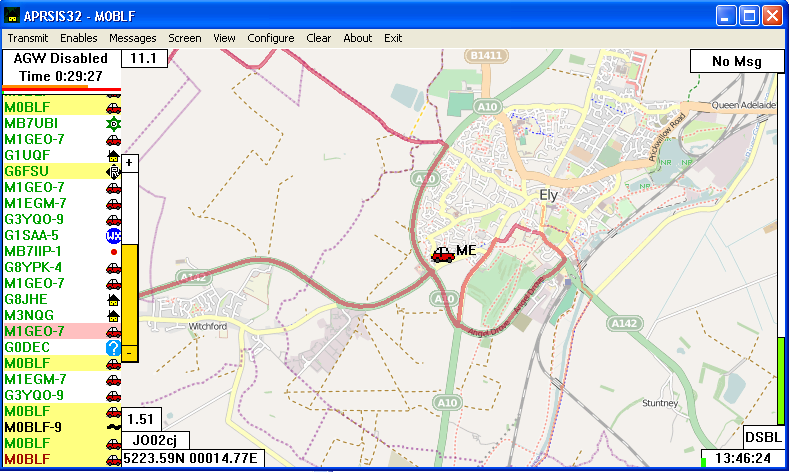
It’s probably fair to say that, since the demise of UIView, APRSIS32 is the most advanced APRS software for Windows that’s under current development. Unfortunately, it’s also got a really steep learning curve, partly because of its origins in the Windows CE world, which means it breaks many of the conventions common to Windows desktop applications.

Whilst there are many getting started guides on the internet, I struggled to find one suitable for Raynet operators who just needed to get APRSIS32 working in a control station type environment.

Since I had decided this needed to be the topic of the August 2013 training evening for Cambridgeshire Raynet, I made on myself, which I’ve made available for download below.

Using APRSIS32 (PDF download)