Category Archives: Contests

CQWW CW 2021 as CT9/M0BLF

Equipment and category

After months during which we haven’t been able to travel because of Covid-19, and with a load of annual leave to use up at work, I thought it would be good to get away for a bit of a break at the end of November. I booked a hotel in the main town of Funchal, on Madeira’s South coast and then, a few days after booking, realised that the dates I had chosen included CQWW CW.

Madeira itself should be a good location for the contest. Plenty of sea paths to both Europe, Africa, North and South America, and with the island counting as in Africa for DXCC purposes, most QSOs are worth 3 points. On the other hand, Funchal is clearly not a good radio location. It’s very built up and is in a bay facing south, with take-off to everywhere interesting blocked by steep hills rising to the high part of the island. If I wanted to operate, it would have to be a portable affair.

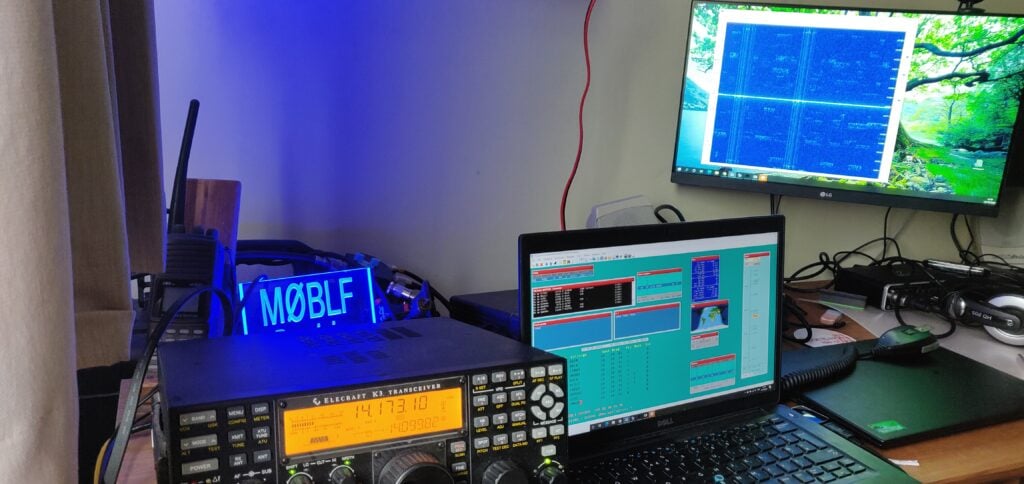
Power was clearly going to be my main limiting factor. I would have no access to make electricity and as I was arriving by plane only the day before the contest, I would have no ability to carry large batteries or obtain a generator. After some quick calculations, I realised that a lightweight 8Ah LiFePo4 battery (which usefully falls just under the 100Wh airline limit) would allow me to operate for at least 5 hours per day using my KX2 on 5W. The problem then was a laptop battery. I had only about 2.5 hours of power on my laptop’s internal battery, so I bought a spare (again having checked the plane would allow it), which would allow me to operate for 5 hours or so on that too. My plan was to return to my hotel room overnight to charge everything, giving me about 10 hours’ maximum operating time in the contest.

It was clear that this limitation meant I’d need to operate in a QRP section and single band seemed most appropriate. During the SSB contest in October, 15m had performed much better than expected and so this became the natural choice as it would mainly be open in the afternoons, matching my 5 hour operating limit well. To use the power available as best as possible, I’d need a resonant antenna, so I built a 1/4 wave vertical with elevated radials and disabled the ATU in my KX2. I chose this particular antenna design because I’d experienced great DX performance from it on previous DXpeditions. Finally, I opted to keep life as easy as possible for myself given the compromised setup, so I chose to operate in an assisted category. Because I wasn’t sure I would have a good mobile phone signal, which would form the basis of my DX Cluster access, I set a filter on my preferred DX Cluster node, so that the Cluster would only send me spots on 15m that did not contain ‘FT8’. This massively improved the throughput.

During the LZ DX Contest at the start of November, I then tested all the gear from home on battery power only to check whether it would work and was amazed to get quite a few contacts. This was a promising start.

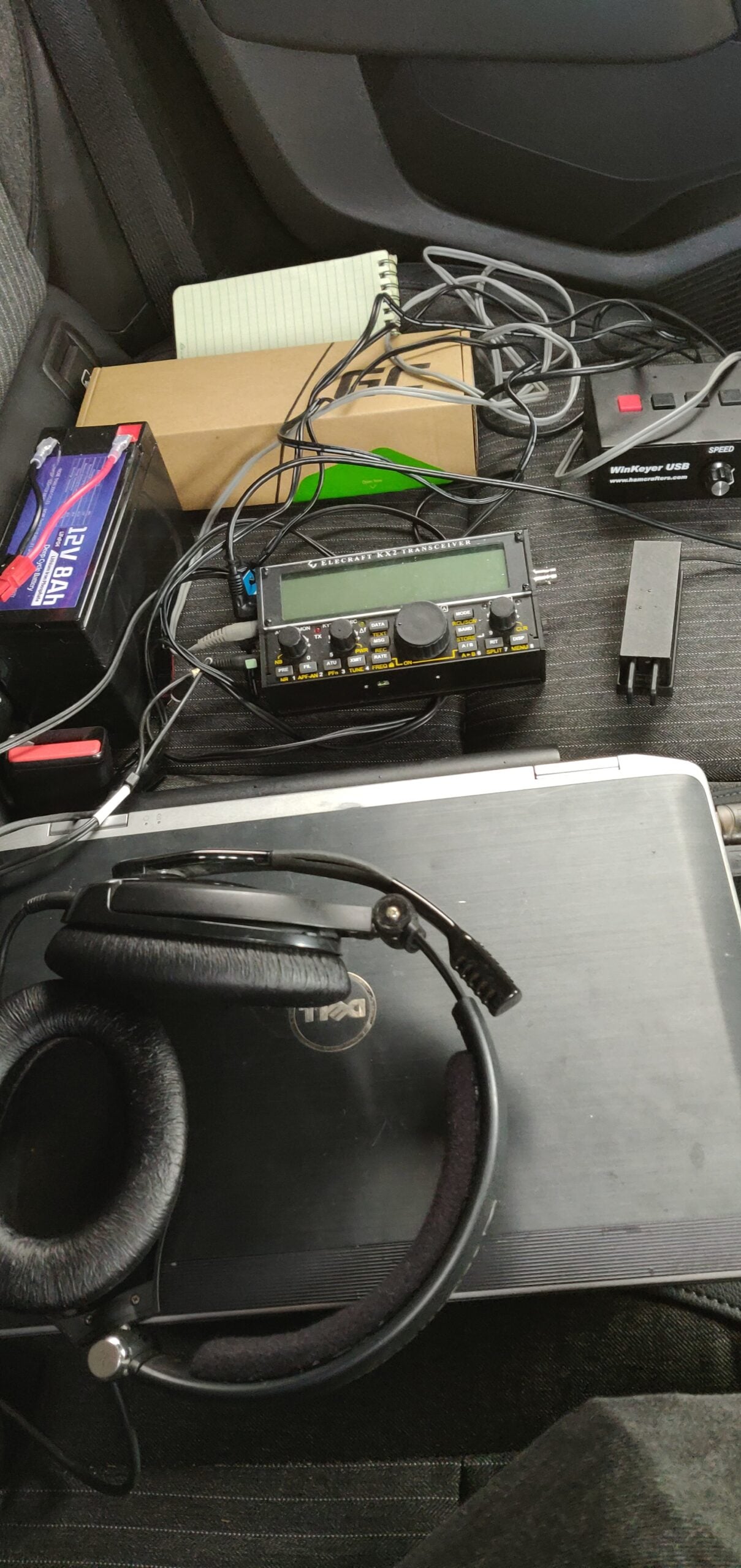
The full equipment list:

  • 1/4 wave vertical with elevated radials
  • 10m fibreglass pole and guys
  • RG8 mini coax
  • Elecraft KX2
  • LiFePo4 12V, 8Ah battery and DC lead
  • Palm mini paddle
  • WinKeyer USB (CW interface for the computer)
  • KX2 USB control cable
  • Laptop running DXLog
  • Spare battery for laptop
  • Headset
  • Mobile phone for internet access via tethering
Equipment

Location

Now that I knew which category I would enter, I needed to choose a location. Clearly Funchal itself was not suitable because of the geography, but I knew from my previous SOTA trips to the island that there’s a large, high plateau rising to around 1800m in the centre of the island, from which you can get great sea views. I chose a spot near Fanal but as the weekend of the contest approached, the weather forecast started to suggest that operating outdoors wouldn’t be possible. I therefore chose a backup location, which was the carpark from which I had previously started the ascent of Pico Ruivo do Paul. The take-off wouldn’t be so good from there but it gave me the option of operating from inside my hire car.

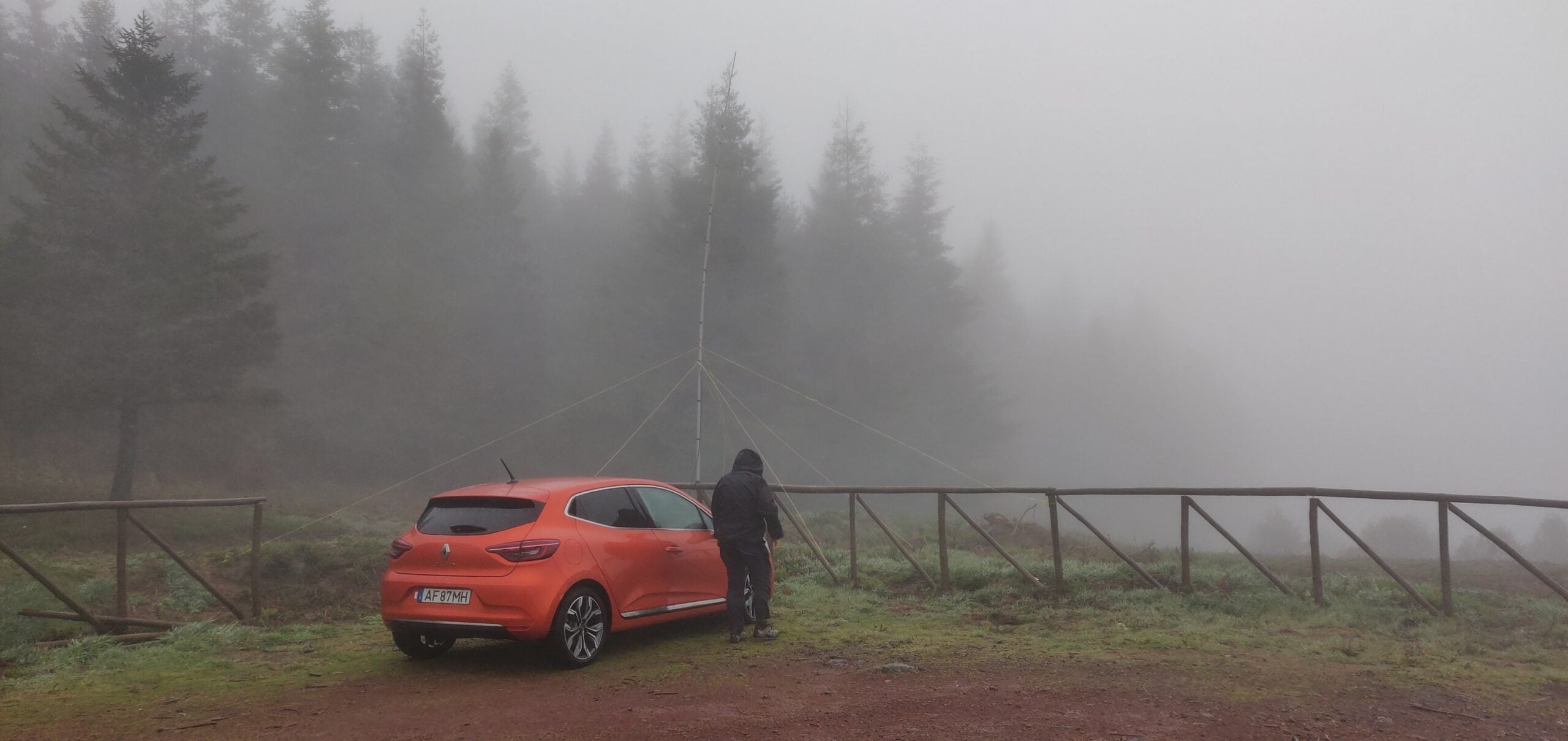
It was lucky I had this backup plan. As I drove to the site on the Saturday morning of the contest, the weather became steadily worse. A number of rockfalls had caused a couple of cars to get punctures, and as I climbed, the mist became thicker. By the time I reached the carpark, visibility was almost nothing, there was a strong wind with gusts rocking the car, sheets of heavy rain and the temperature was an unseasonably cold 4c. This contest was going to be quite a challenge!

Using the wooden fence in the otherwise empty carpark, I tied on the antenna pole, used a guy set and deployed some bungee cords too, and somehow that was sufficient for the pole to survive.

Operating from the car’s back seat was a little cramped, but with the laptop on my lap, and KX2 by my side, I managed to get comfortable. I was glad I was only planning to do about 4.5 hours each day, though (to give me a little spare battery power).
The weather was awful!

The contest

The contest itself went quite well. Take-off to Europe wasn’t quite as good as I had expected, but South America and North America were quite easy. By the time I was packing up at 4pm on the Saturday with little battery power left, the Americas were coming in easily, so on the Sunday I adjusted my start time to allow myself to stay a little later, though at the expense of some of the morning opening to Eastern Europe. I was particularly pleased that a lot of the Americans, even the Zone 3 ones, seemed to copy my call first time, which indicates the antenna and sea-path take-off were doing their job. However, with just one exception, my CQ calls weren’t seen by the RBN, and so all but handful of contacts were made S&P, which clearly limited my rate. Interestingly, I tried multiple different CW sending speeds and found 25wpm to be most likely to get my long callsign (CT9/M0BLF) copied accurately.
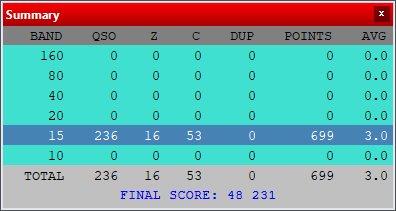
Final score: 48231 points claimed

CQ WW SSB 2020

For the last 15 years I have almost always operated CQWW SSB from M4A in the multi-single or multi-two categories. It’s one of the highlights of my year. However, with the current coronavirus situation limiting our ability to meet up, I found myself limited to a single operator entry this year.

I decided to go for the SOSB(A) on 20m category, both since I can fit a 20m dipole into my garden and also the fact that 20m is closed overnight, thereby allowing me the chance of at least a bit of sleep! And (controversial opinion follows…) of course I went for the assisted category, because I don’t see why you’d want to make life hard for yourself by denying the existence of the DX Cluster!

Running just 100W into a dipole hastily constructed the day before the contest, I set myself a modest target of 200 QSOs for the weekend. That wouldn’t be enough to win anything but I could at least feel that I had made a meaningful contribution.

Equipment

  • Elecraft K3
  • 20m dipole at about 7m AGL
  • DXLog.NET for logging
  • Waterfall Bandmap, fed from a FunCube Dongle Pro+, taking the K3’s IF feed, for panadapter (My set up instructions)

The entry

I was actually very surprised! Although it was certainly hard going with relatively low power, I had made my target of 200 QSOs by Saturday late afternoon. This was entirely search-and-pounce, and I spent a lot of time chasing multipliers. That said, by the end of the day, I was still missing entities and zones that should have been fairly easy, like Asiatic Russia.

I didn’t expect to get very many more QSOs on the Sunday as I suspected I had worked all the easy ones, but to my surprise there were plenty of Europeans still to work. I quickly decided to adopt a strategy of trying to get as much of a rate as I could S&P, so that I could optimise my score after focusing on DX the day before. This strategy paid off, and by the afternoon I even found a clear frequency where I could try running. I could only hold a frequency for about 15 minutes at a time, but it was enough for a few countries I might otherwise not have got (such as 9H and GI) to call me.

I was somewhat surprised how late after sunset the band stayed open on Sunday evening (I didn’t declare the band dead until 21:30 UTC) and this allowed me to get several more US stations and even to get my best DX of the contest, PX2A. Thanks to all the stations who struggled to pull my weak signal out.

As for the dipole’s performance, I was very impressed. Although I didn’t manage to work them, I heard VK3, YB and 9G, so it certainly worked well. I didn’t manage to hear any JAs, even though I was aware from the cluster of a good opening to them on Sunday morning. I suspect this was because I’d deliberately orientated the dipole to fire to the North-West and South-East to optimise paths into Europe and the US. As you’d expect for my low power setup, 82.2% of my QSOs were in Europe, with Italy and Germany the main countries.

Results

Contest : CQ World Wide
Callsign : M0BLF
Mode : SSB
Category : Single operator
Overlay : ---
Band(s) : 20
Class : Low
Grid square : JO02BG
Operating time : 29h 10m

 BAND QSO  Z  C DUP POINTS  AVG
-------------------------------
  160   0  0  0   0      0 0.00
   80   0  0  0   0      0 0.00
   40   0  0  0   0      0 0.00
   20 493 14 62   2    667 1.35
   15   0  0  0   0      0 0.00
   10   0  0  0   0      0 0.00
-------------------------------
TOTAL 493 14 62   2    667 1.35
===============================
      FINAL SCORE: 50 692

Operators : M0BLF
Soapbox :
Created by * DXLog.net version 2.5.0 by 9A5K *
http://www.dxlog.net

RSGB SSB Field Day from G3PYE/P

This weekend saw the annual SSB Field Day event and once again I took part with the Camb-Hams at G3PYE/P.

For the past couple of years, we’ve entered with a checklog because frankly life is too short for QRP and we got a lot more enjoyment from the contest by using an amp. This time, however, we decided to stick to the rules and use 100W only, so we could put in an entry.

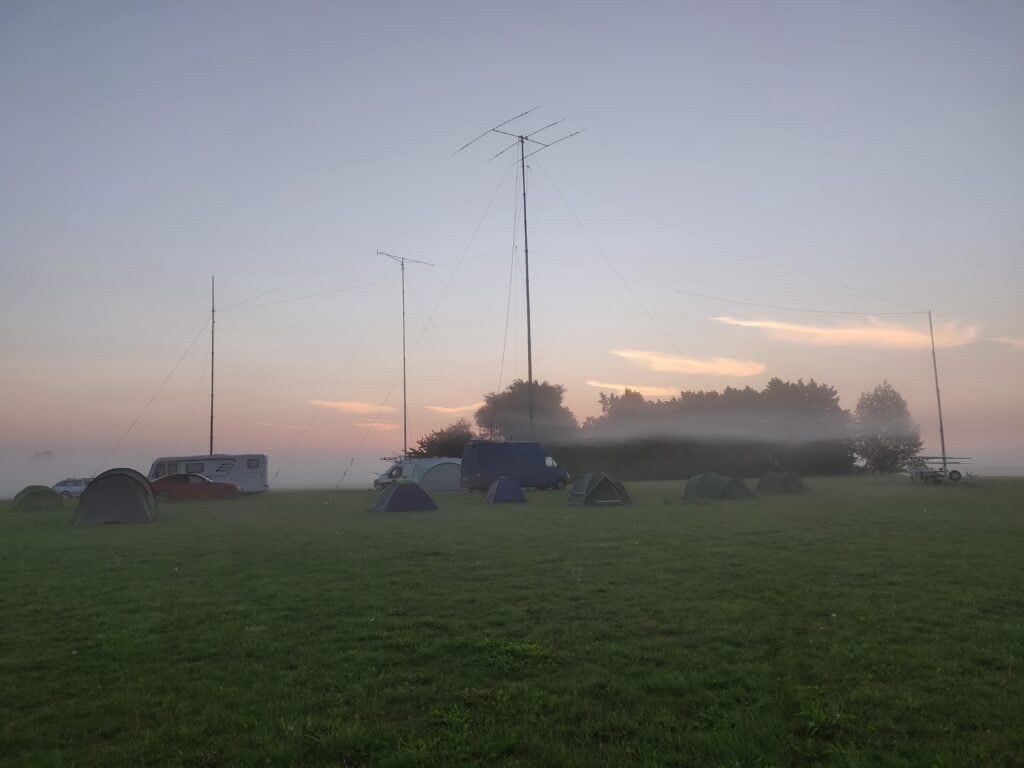
Early morning at G3PYE/P. A3S on Amy (also the centre of two dipoles), and 17-ele for 2m on Flossie. The trailer mast and campervan are just dipole supports.

On the Thursday evening before the contest, we got some bad news: our normal operating location wouldn’t be available and so massive thanks need to go to M0VFC, M0ZXA and many others who spent Friday trying to secure an alternative field at one day’s notice. Amazingly, they found a location to the north of Cambridge, only 4m ASL, but surrounded by flat fen land. On the Friday evening, we gathered at our newly-found location to start setting up some of the equipment.

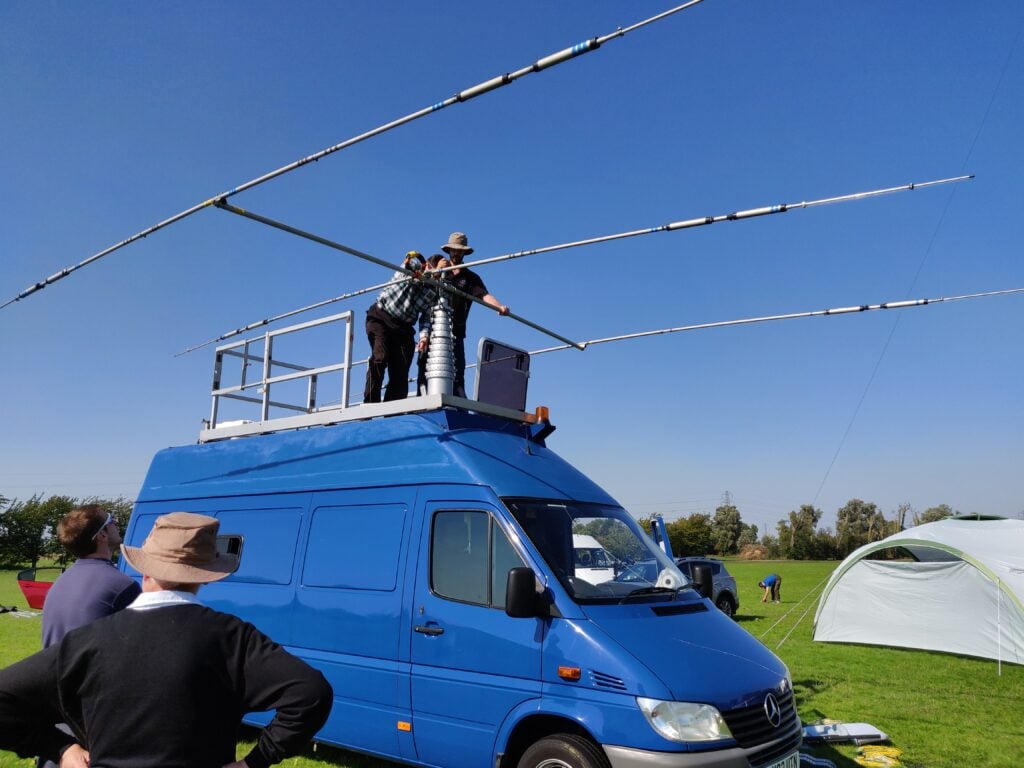
Most of the set-up, however, was done on Saturday morning. We actually weren’t only operating in SSB Field Day but also in the 144MHz Trophy contest (although given our low location and the fact we only had a single 17-ele beam, we knew we wouldn’t win on 2m). We soon had the 2m beam mounted on the Camb-Hams van, Flossie. Shortly afterwards, Flossie’s sister, Amy, arrived courtesy of G4CWH, and we installed an A3S beam for 20m-10m and dipoles for 40m and 80m on Amy’s more substantial mast.

A3S going onto Amy’s roof

I didn’t operate on 2m, but our setup there was an Elecraft K3 with XV144 transverter and a Beko amplifier.

On HF, we also used two Elecraft K3s straight into the antennas. With the K3’s clean signals, there was no need for bandpass filters. This was as well, because, in order to comply with the rule that you can only have one signal at a time, we needed to use the ACC port on the K3s for a hardware interlock (see the TX INH menu item in the K3 manual for details on how this works).

Although I’ve tried interlocked multi-station operation before, this was the first time M0VFC and I actually got it to work. The theory is straight-forward enough: each station interleaves their overs such that one station is hearing a reply while the other calls someone. It takes a lot of timing, and awareness of the stage of the other operator’s QSO, and above all competent operators on the other end of the QSO(!) but it can give some fantastic rates.

I don’t have a copy of the log to give a final summary (yet) but QSO total was in the region of 700 QSOs. We were very pleased with this, especially given the hastily found location.

CQ WPX SSB from GB2GP

I’m a couple of weeks late writing this post but on the weekend of 23-24 March, I again headed down to the UK Scout Headquarters station at Gilwell Park to join the team operating GB2GP for the CQ WPX SSB contest.

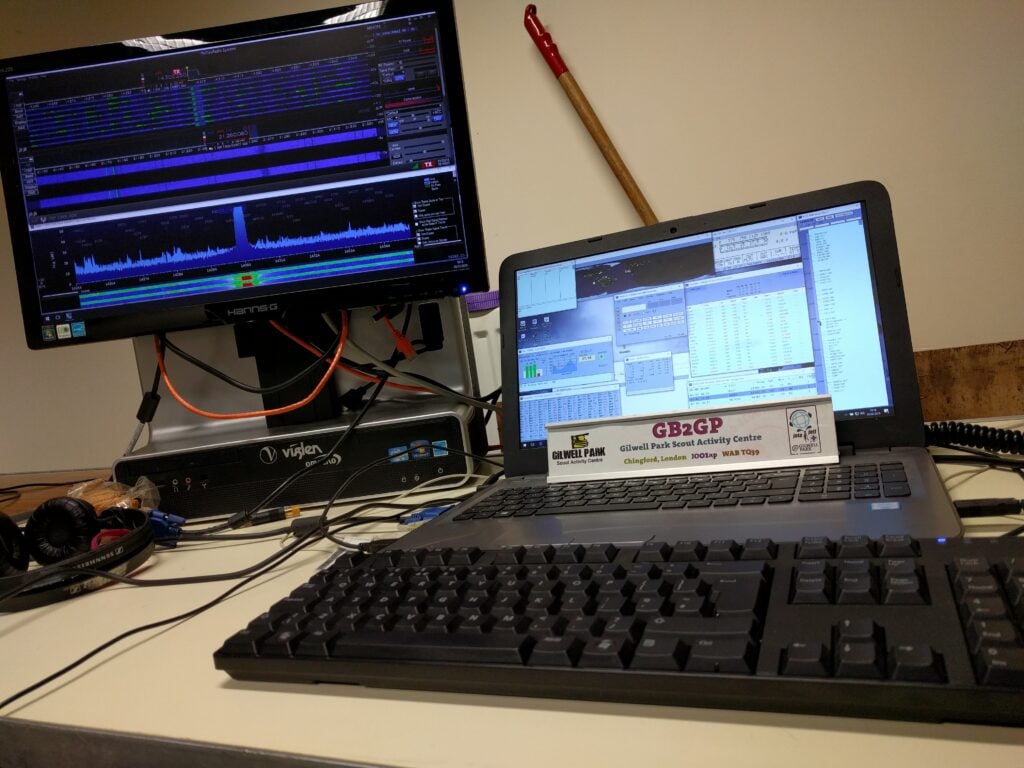
GB2GP during WPX

Rather than me repeat what has already been said, a write-up of the event is in the UK-HF-Contesting reflector from Steve M0BPQ.

Claimed scores were:

Band     QSOs     Pts  WPX  Pt/Q

   3.5     437    1106  253   2.5

     7     690    1734  256   2.5

    14     877    1699  350   1.9

    21     122     296   57   2.4

 Total    2126    4835  916   2.3

Score: 4,428,860

As in the ARRL contest a few weeks ago, it was really interesting using the Flex as a contest rig. I think I could get used to it. I’m still not convinced by N1MM, though, and feel far more at home with Win-Test / DXLog.net. Most of the usability issues we found seemed to be caused by the Flex / N1MM interplay: in particular, N1MM’s multiplicity of windows means that the right thing has to be focused at the right time, which is hard if you are also using a software defined radio.

As ever, many thanks to the Gilwell Park team, and particularly Steve M0BPQ and John 2E0XLX for having us.

ARRL DX SSB at GB2GP

Last summer, I spent a week at the UK Scout HQ, Gilwell Park near London, for the YOTA event.

This weekend, I had the opportunity to return to the shack to help operate GB2GP – the permanent special event station for the Scouts – in the ARRL DX Contest.

It was a really fun weekend, even if conditions were bad. It was so bad that at one point, once 40m closed on the morning, there was almost 2 hours with no QSO before 20m opened, during which I had just one QSO. There were very few times when more than one band once open to the US/Canada at once, but I did get a decent run on 15m on the Sunday lunchtime, which helped.

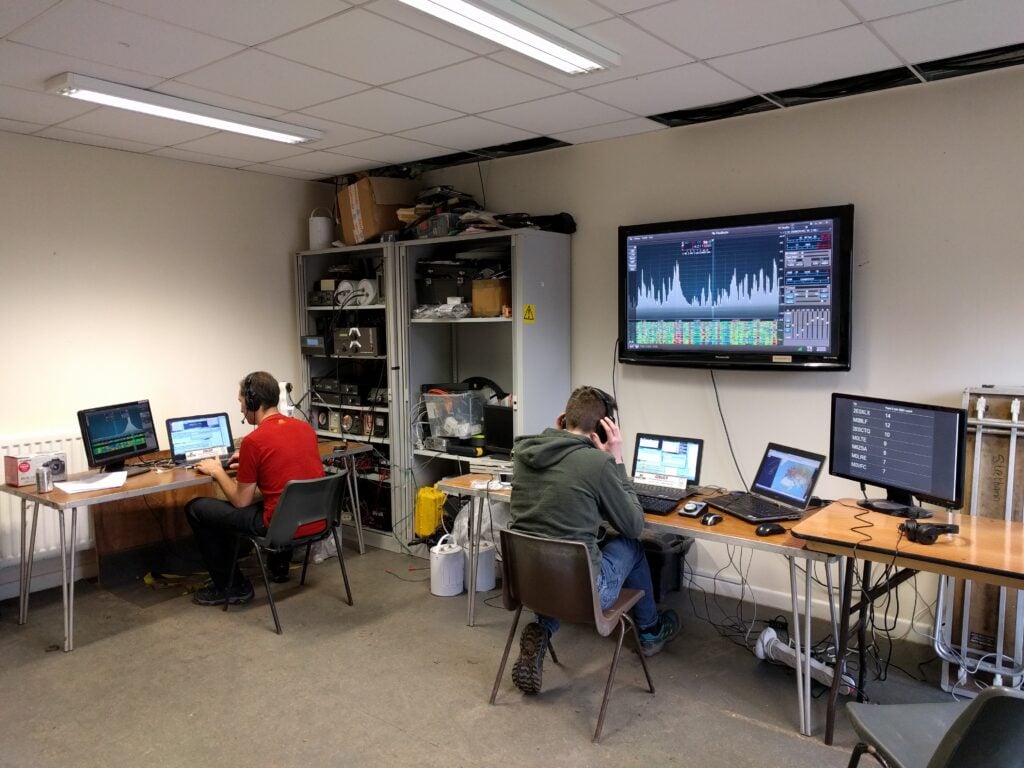
The operating position at GB2GP

We were entering in the multi-two category, as a tactical measure, but we actually operated with only one radio. This was my first time using a Flex SDR in earnest and I seemed to get used to it quite well. Also new for me was N1MM+, which also seemed to perform once I had got used to it (though I’ll probably stick with Win-Test / DXLog.net for most of my own contesting).

The other novelty for me was this was my first contest using a Beverage antenna for the lower bands, and particularly 80m. This seemed to work really well, particularly given the amount of noise the transmitting antenna was subjected to, emanating from the nearby Brookmans Park broadcast transmitters.

Final QSO total was just over 1000 QSOs. While that might not sound fantastic, being a training station, a large part of the focus was on having a mix of skills there, from a couple of us who were relatively experienced contesters, through to one person who hadn’t been on HF in years.

Most importantly, I had a good time and it was great to work with a different group of enthusiastic people. Thanks to the GB2GP team for having me!

RSGB 432MHz AFS from M1BXF

We always aim to have at least five stations on from the Camb-Hams for any of the AFS events, because it’s the top four scores in the team that are counted for the Super-league, and you never know when failure might befall one of the stations.

Today, it was our turn to suffer from equipment problems.. I was operating from Gavin M1BXF’s QTH near Newmarket with Mark M0MJH. All was going well before the start of the contest but just two minutes before the beginning, while checking signals with G3PYE/P, our receiver suddenly became deaf.

The fault was quickly diagnosed as a failure of the masthead pre-amp, which meant that the mast had to come down as the contest was starting. While Gavin concentrated on fault-fixing, Mark and I carried on the contest using a mixture of an X-Quad 9-element satellite antenna (the first time I’ve used right-hand circular polarisation in a contest) and the 2×21 ele stacked yagis, once the pre-amp was off the mast. As you would expect, the lack of pre-amp in the stacked yagis meant that we really struggled to hear the most distant stations. Sorry if you tried to contact us and we couldn’t hear you.

Gavin trying to fix the pre-amp mid-contest

Despite the handicap, however, we finished with an OK score of 57 QSOs. Best DX was MM0CEZ on CW, with only one French station worked, even with the overlap in the British and French contest times.

And with this contest, we’ve reached the end of the AFS Super-league season, which started back in October. So far, it’s looking good overall for the Camb-Hams, but we’ll see what happens in the final results.

Update: Results have now been published and, as expected, we were put in the Camb-Hams B team, which came in 13th place overall. Camb-Hams A came in 2nd place, which was sufficient for Camb-Hams to come first in the AFS Super League for the 2017-18 season.

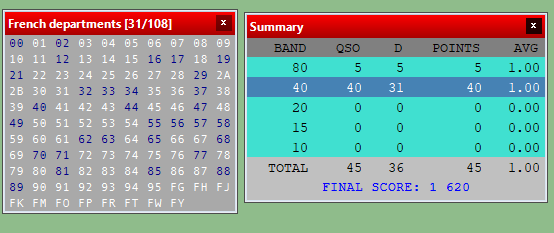
A non-serious entry in REF-CW 2018

I had a bit of spare time over the weekend, so gave away a few points in the French REF-CW contest.

Equipment was my Elecraft K3 with just 40W out (to prevent QRM to neighbours) to my 30m dipole, tuned onto 40m. I’m not entirely sure how effective this was. Many stations seemed to struggle with my callsign, so I suspect I wasn’t very strong to them. Having said that, conditions on 40m did also seem genuinely rubbish with deep QSB. On a number of occasions, someone who was S9 when CQing was S0 and unreadable by the time they were giving my report – very frustrating!

I did try 5 QSOs on 80m but it was clear I was very weak there and everyone was struggling to copy me. That wasn’t a surprise, as my 30m dipole required several attempts by the K3s ATU to make it semi-happy, so I quickly abandoned.

REF CW 2018 scores and mults screenshot

My log will be published automatically on 1st February.

RSGB 80/40 Affiliated Societies Contests 2018 – G3PYE

I operated with Rob M0VFC for the three RSGB 80m and 40m Affiliated Society Contests in January 2018 from Flossie, the Camb-Hams van, at our Worts Causeway site (JO02CE).

CW (Sunday 7th January)

This was a very fun event. We were using two Elecraft K3s, one with a KPA500, and the other with a Juma amplifier, to dipoles. The 80m dipole was at the top of Flossie’s mast, and the 40m was parallel with the centre about halfway up the mast. Despite this, there were no discernible interactions between the antennas.

We were about 20 minutes late on, just by virtue of having been late on-site, but we were still able to take advantage of about 40 minutes good inter-UK propagation on 40m before changing to 80m.

Once we were underway properly running on 80m, we then started interleaving S&P QSOs on 40m, using a simple interlock cable on the K3s to keep us abiding by the rule only to transmit on one band at a time. (The running station was master, and could transmit at any time; the S&P station was slave, and could only transmit when the master was not in transmit).   It did take us a little while to get used to watching each other to avoid transmissions being interrupted by the interlock, but it netted us a nice few GMs and EU stations while allowing the 80m station to keep the run frequency.

Thanks to M0PCB’s fantastically quick adjudication, we now know that we came joint 28th overall, with 230 points. This put our entry into the Camb-Hams B team, which came 7th overall (with Camb-Hams A coming first).

We had double the average amount of errors for the contest in our UBN, so that’s something to work on for next year!

SSB (Saturday 13th January)

We were late on again for SSB – this time due to multiple failures of the 80m dipole – which meant that we missed the fact that lots of people gave up on 40m early because of conditions and the QRM from the Italian contest. This, in turn, meant that we were late getting down to 80m.

Once we were running, though, we got some good rates. We again interlocked the two K3s, and this was much easier on SSB as we could hear what each other were doing, of course. At times, it was even slow enough for us to operate 2O2R3V (two operators, two radios, three VFOs!) as the running operator could S&P on the B VFO in-band, as well as CQing!

We got a score of 228 points, giving us 22nd place overall. This again put us in Camb-Hams B team, which came fourth overall. Again, we were pleased that Camb-Hams A were first.

Data (Saturday 20th January)

Rob M0VFC on the RTTY data station

The inclusion of datamodes in AFS this year is new, and it gave us our first experience of a datamodes contest. I’d only briefly dabbled before, and Rob had never touched RTTY or PSK.

Despite another failure of the 80m dipole, we were set up on time. The start was very slow, however, and for a while we thought something was wrong. However much we called on 40m, nobody came back to us. Some S&P proved that there was nothing amiss, though, and returning to running, everything suddenly came to life.

This time we didn’t operate with two radios: we weren’t experienced enough for that. We did however use the second K3 to monitor our transmitted signal with no antenna connected, thus giving us confidence that we were ‘clean’.

At time of writing, we haven’t got adjudicated results yet, but our claimed score is 171. This looks to be a pretty good score. Most interesting is that the highest scores in both the 100W and 400W categories look very similar, and the fact that 172 is much less than the ~230 points we got in the other two legs. This seems to confirm our suspicion at the time that the contest was activity limited, rather than limited by conditions or equipment. If so, that could do very interesting things to the wider AFS Superleague results.

Update: The results are now out and, amazingly for our first data contest, we got a completely faultless log. As such, we placed in the Camb-Hams ‘A’ team, which came second to Norfolk ARC ‘A’.

CQWW CW from CE3/M0BLF/7

This post is about my entry from Chile in the CQWW CW Amateur Radio contest. If you’re not a radio amateur, and you’re just interested in following my travels in Chile, you probably want to skip this post in the series.

Similarly, if you are a radio amateur and you’ve come here to find out about my contest entry, you may not realise this was part of a 6-week journey through the country. I was travelling light, which explains the lack of decent equipment!

Score

Firstly, the bit you’ll be most interested in:

Contest         : CQ World Wide DX Contest
Callsign        : CE3/M0BLF/7
Mode            : CW
Category        : Single Operator (SO)
Overlay         : —
Band(s)         : Single band (SB) 15 m
Class           : Low Power (LP)
Zone/State/…  : 12
Locator         : FE38LU

BAND   QSO  CQ DXC DUP  POINTS   AVG
————————————–
15    34   7   6   1      86  2.53
————————————–
TOTAL    34   7   6   1      86  2.53
======================================
TOTAL SCORE : 1 118

Equipment

I was very limited for space for this activation, as I only had one 23kg suitcase and one backpack that had to contain everything I needed for 40 days’ travelling, including camping gear. As a result, the equipment used was:

  • IC-706Mk2G
  • Gel cell battery (12V/12Ah) – purchased back in Temuco
  • 15m dipole at about 3m AGL – that’s as high as I could get it given a lack of trees around the camping pitch
  • WinKeyer USB
  • Laptop with Win-Test

and that was it. I had brought my Bencher paddle (despite the weight!) but it had developed a dodgy connection and I hadn’t brought a soldering iron, so I wasn’t able to send manually. Unexpectedly, however, I did have the ability to recharge the gel cell on my camping pitch, which meant I was able to operate for longer than originally expected.

Given the fact that I was under battery power, I had to keep the power down. I typically limited it to about 40W. For anyone who hasn’t tried to operate in a major contest with this restriction, it’s an interesting experience. I found myself pondering the optimum gap to leave between CQ calls, as every unanswered call was potentially wasted power. I also had to choose operating times carefully, of course, to allow time for recharging in the quieter periods. I’d listened to 15m the previous weekend (during Sweepstakes), while I was in Villarica, to aid this choice.

My entry was SOSB on 15m, unassisted (there was no internet on the campsite).

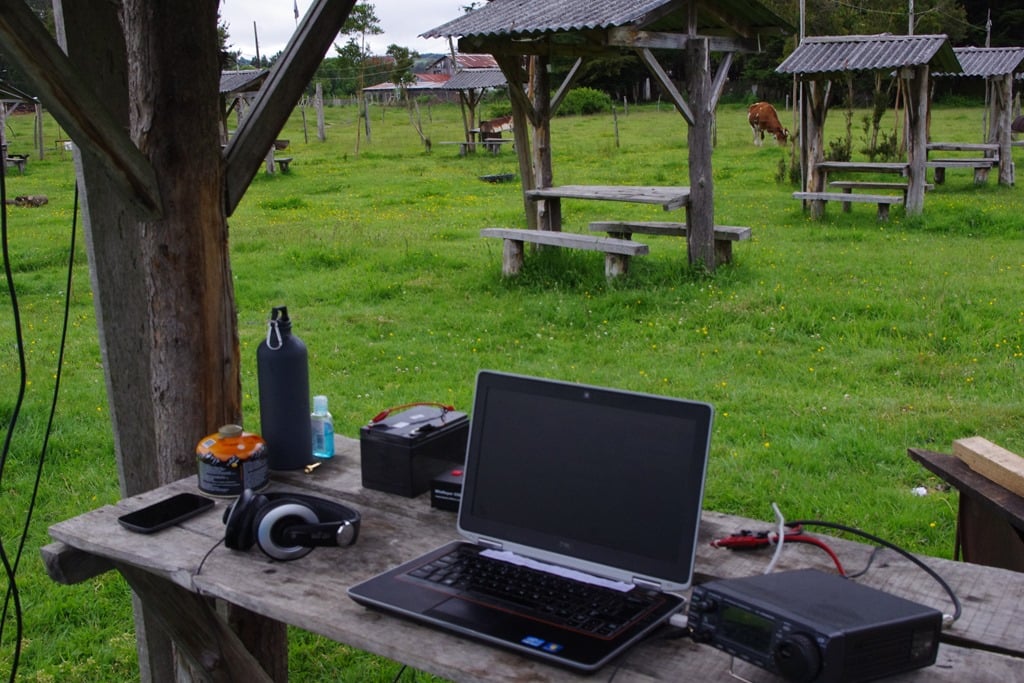
My limited station on the campsite, which is also a working farm, hence the cow in the background. The dipole was strung between a couple of the shelters.

Conditions

Conditions were broadly worse than expected, even given my limited equipment. I could tell I was a long way south, and far from most major centres of population. The European opening predicted by VOACAP around midday UTC was certainly there, and there were some fairly big signals from Europe but when called they either couldn’t hear me or, in some cases, got a partial call then gave up before getting the rest.

Outside of the contest, it was good to work two friends in Cambridge (Martin G3ZAY and Rob M0VFC, both operating from the G6UW Cambridge University Wireless Society shack) on the Sunday EU opening, which proves the path was there with a bit of effort.

There was a better opening to the USA in the late afternoon / early evening local time (around 21 UTC), which is where I got most of my QSOs on the Saturday, but not so many on the Sunday. Even when I could tell I had been spotted, it didn’t sound like I had many callers, though. I wonder whether that was me not hearing a pile-up, or whether it wasn’t there.

Callsign

So, what was with the strange callsign I was using? I’d been issued the callsign CE3/M0BLF via the Radio Club de Chile. Since I wasn’t staying in a single place during my trip, they kindly let me use the Radio Club HQ address for my licence address, which is why it was issued in zone 3 (Santiago).

I wasn’t in Santiago for the contest, however. I was in the Región de los Ríos, most of which is zone 7. Hence CE3/M0BLF/7.

If you had understood I was expecting to be CE3/M0BLF/6 in the contest, that’s correct. The different zone was a result of moving campsite unexpectedly. If you want to know why I moved, there’s more information on the Entre Lagos blog post.

Electricity supply

Although I was using batteries for the contest, I know that many radio amateurs like to know about mains systems for their own travels, so this bit is for you!

Chile has a 220V, 50Hz mains supply, similar to most of Europe (but unlike North America). The plugs used are ‘Type C’, which I hadn’t come across previously.

By design, Type C plugs have a very useful feature: the middle pin is the Earth and the two outer pins are Live and Neutral. These are identical in dimensions and separation to the continental European ‘Schuko’ standard, which means a European plug will work fine in a Type C socket, as long as you don’t need an Earth connection (and let’s face it, a lot of equipment is double-insulated these days).

There is a catch, however: Chile is increasingly moving towards what I gather are called ‘Type F’ sockets. These look superficially identical to Type C, except that the Live and Neutral pins are physically blocked off unless the Earth pin is also present (this is also a feature of British Standard sockets, of course). This means that standard Schuko plugs won’t go into a Type F socket, even though it looks the same as a Type C.

For guidance, I found that every hotel room – even more modern ones – I went to had at least one Type C socket in the room, but Type F were understandably more common in bathrooms and on campsites, for example. A casual look around some shops suggests that it may no longer be possible to buy Type C sockets for new installations, but I don’t know whether that’s just due to them only having Type F in stock, or by legislation. Anyway, when I did need one, I was easily able to pick up a cheap Schuko – Type F adaptor in a larger branch of the Jumbo supermarket, complete with Earth pass-through. I also bought a 10m Type F extension lead, which was useful for hooking-up at campsites during my travels.

Response to the RSGB Contest Committee’s whitepaper – May 2014

On 26th May 2014, the RSGB Contest Committee announced a Whitepaper containing proposals and suggestions for various rule changes. [Whitepaper]

I really welcome this development. It’s great to see the Contest Committee so engaged and keen to hear feedback, and also I like having a clear timetable for the decision-making process based on this feedback.

It was subsequently suggested on the uk-vhf-contesting reflector that it would be interesting to discuss some of the options, and for that reason I’m publishing my response below.

My feedback on Rule Change Proposal Whitepaper