Basque Country SOTAs: Aratz

I’ve recently returned from a few days in the Basque Country, which included a few summit excursions. Although I’m aware that I’m behind on writing up some of my other SOTA trips over the summer, I’ve decided to type up my notes on this recent trip first before I forget the detail.

Aratz EA2/VI-003 (6 points)

Having landed in Bilbao, Spain, I hired a car and drove for about 90 minutes to the car park which serves both Aratz (EA2/VI-003) and also Aitxuri (EA2/SS-001). The car park itself is located near the end of the GR-282 road at 42.9351, -2.3032. The GR-282 itself is a concrete road but perfectly decent to drive over.

From the car park, you head on the path through the trees and over the bridge. The path soon opens out to a wider area, but it is obvious and without any particular navigational challenges. Note only that at this point you are heading away from the summit – this is because the summit itself is above a steep cliff face, and so the path heads around the side in order to reach a shoulder where the access is easier.

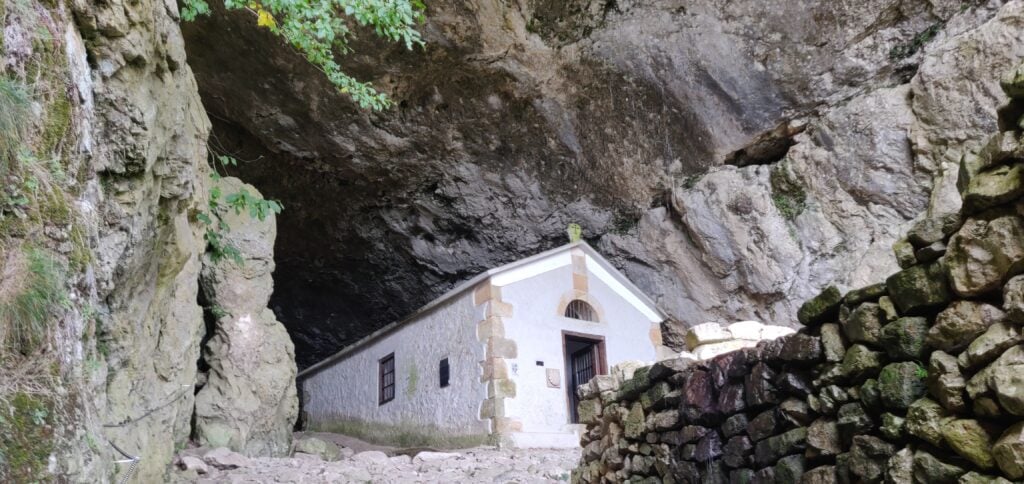
At 42.9352, -2.3153 you reach the fascinating natural tunnel through the ridge which contains a chapel at the site of a former hermit’s dwelling, the San Adrian’s hermitage.
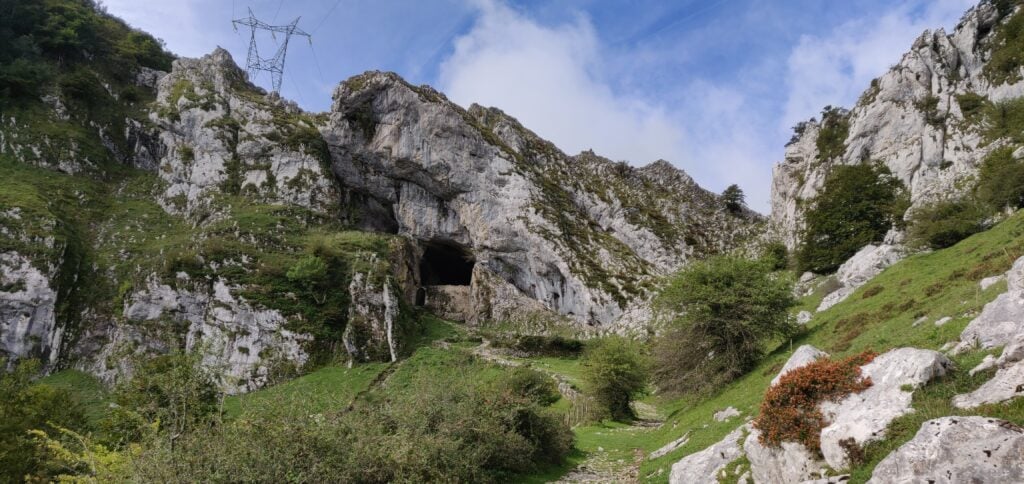
The tunnel at San Adrian’s hermitage
The hermitage chapel

Continue walking through the tunnel but be wary of where there are drips onto the well-worn cobbles – the stones were quite slippery in places.

After the tunnel continue on the main path and where the route splits follow the white and red paint markings to the left, signposted to Gazlaren Ibilbidea. This brings you to another fascinating feature of the walk – an intact Roman road taking you back into woodland.
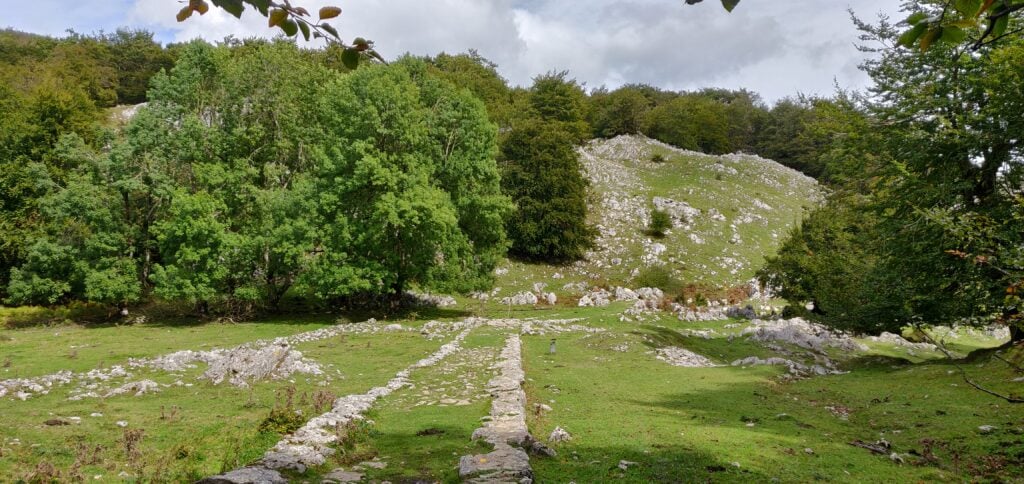
Looking back down the Roman road

Shortly after you’ve picked up the Roman road, watch for where the road bends around to the right and look for a small, muddy track through the trees straight ahead of you, marked with yellow dots of paint. This is the route to the summit of Aratz.

Once back out of the trees, you are almost at the summit. The path is narrow but it’s not near the edge and it felt perfectly safe. This final section is the steepest and there’s a misleading false summit to get over before you see the final destination, marked with a trig point.
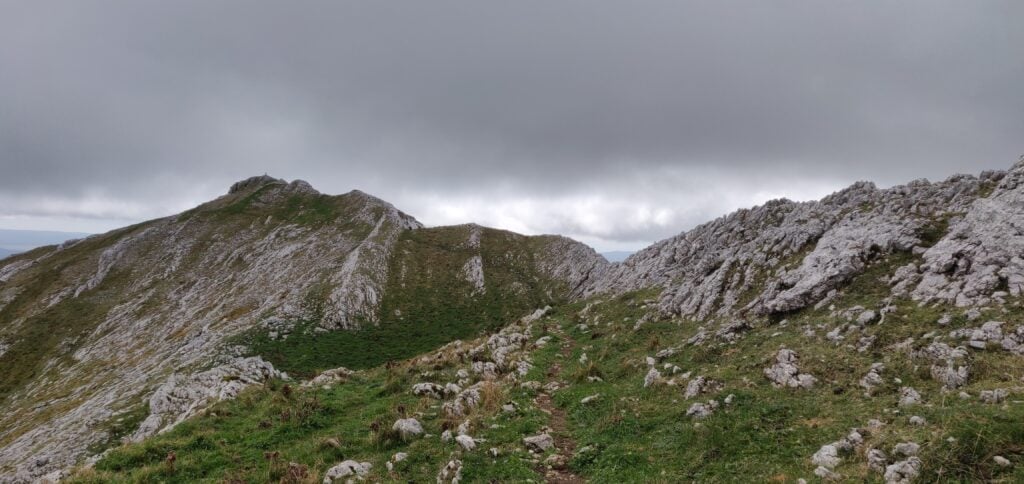
The final ascent

Having reached the trig point, there is a fairly large area, though sloping, that’s within the SOTA activation zone where you can set up an antenna.
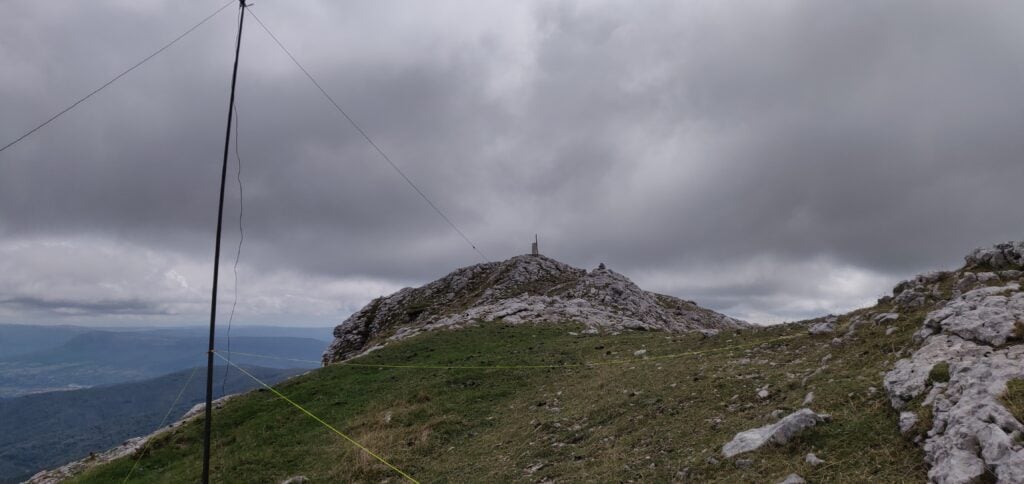
My antenna set up just below the trig point

On a clear day, the summit of Aratz would have a stunning view out to the Bay of Biscay to the North and across the plains of the Ebro valley to the South. As such, the radio takeoff was pretty impressive and I was pleased to make 13 contacts on 30m CW within about 10 minutes.

The ascent (about 580m vertically over 4.4km horizontally) took me 90 minutes and the descent would have taken a little less had I not stopped for lunch. This wasn’t a hard climb and was a very interesting walk.

I had originally planned to go on to EA2/SS-001, since the walk there only diverges from the path to Aratz after San Adrian’s hermitage. However, with a long drive into France still ahead of me and having started slightly later than I had hoped, I decided to head straight back to the car.

Loading map…
Distance
—
Elevation gain
—
Elevation loss
—
Max elevation
—
Waypoints
—
Elevation profile

Hard Reset: A workshop at Agile Cambridge 2019

Back in November at work, we ran ‘Reset Week’. Basically, we had a problem: we had three products needing work and three teams that weren’t quite the right shape and had the wrong skill-sets in the wrong places. But by making the teams gel, the result would be that the resulting teams wouldn’t have worked on their products before. To make matters worse, two of the three products had no roadmaps.

Due to externally motivated deadlines, I was given a week to resolve this. By the end of the week, we would need fully-formed roadmaps (at least to give a few months of runway) and teams that bought into them and understood the products.

How did it go? I’ll be presenting a workshop at Agile Cambridge with my former colleague Roger Hart, where we’ll re-run a compressed version of the week in 90 minutes. Come along and you’ll create your own roadmap working with people you probably haven’t met before…

Wednesday 2nd October 2019 at 13:25 at Churchill College, Cambridge as part of Agile Cambridge…

More information…

Moving on…

It’s time for a bit of work-related, personal news… My career has been one where I’ve followed a slightly unusual path, jumping at opportunities that have presented themselves. From a languages degree to Technical Authoring, then to Agile as a Scrum Master, I’ve been keen to explore different areas in a way that’s hopefully also been useful to my employer at the time.

I’ve been fulfilling a Scrum Master role for more-or-less seven years now, ranging from a highly Agile software company, to an American multi-national, to most recently an academic publishing business, which can only be described as slower-paced. I’ve really enjoyed working with various teams over the years but I’ve struggled to settle into a purely Agile Coach role, often ending up more of a Project Manager (for better, or for worse).

Our current challenge at the Royal Society of Chemistry is a big one, but one that will be familiar to many companies. We’ve grown up with a huge, and largely poorly-understood, legacy in-house infrastructure which has now become unsustainable. Over twelve months ago, we took the decision to take a strangulation approach to it, and gradually rearchitect it in the Amazon Web Services cloud.

It quickly became evident, however, that even after this decision had been taken, there was little movement in actually spinning up AWS infrastructure and we didn’t have the in-house knowledge to take a best-practice approach to the architecture. As Scrum Master to the team most directly impacted by this – and therefore as the person who was supposed to remove blockers and impediments – this rapidly became a significant concern.

And so, I took it upon myself to throw myself behind the cloud adoption strategy. Last autumn, I passed the AWS Certified Cloud Practitioner exam and I started studying for the Solutions Architect Associate exam. More recently, working with an external consultancy, we’ve been looking at forming a Cloud Centre of Excellence (CCoE), as recommended by AWS. One of the features of a CCoE is to drive the organisational change needed when adopting cloud technologies, and in particular evangelising a DevOps operating model. I’ve also been showcasing the technologies to our stakeholders to help them understand the transformation we’re doing. Both of these aspects are very similar to what I had been doing promoting Agile.

Last week, all this became official. My job title is now a Solutions Architect, still at the RSC, but now in the Site Reliability Engineering team, with the aim of driving our cloud-related projects forward. I’ll still be working on the same cloud migration project with the same people but now in a much more technical capacity. I’m really looking forward to getting stuck into the new role properly as we have the opportunity to make a significant difference. Time will tell, but the team has already delivered some impressive work in the last few months, and I’m sure there’s a lot more to come.