My first six months in a new role

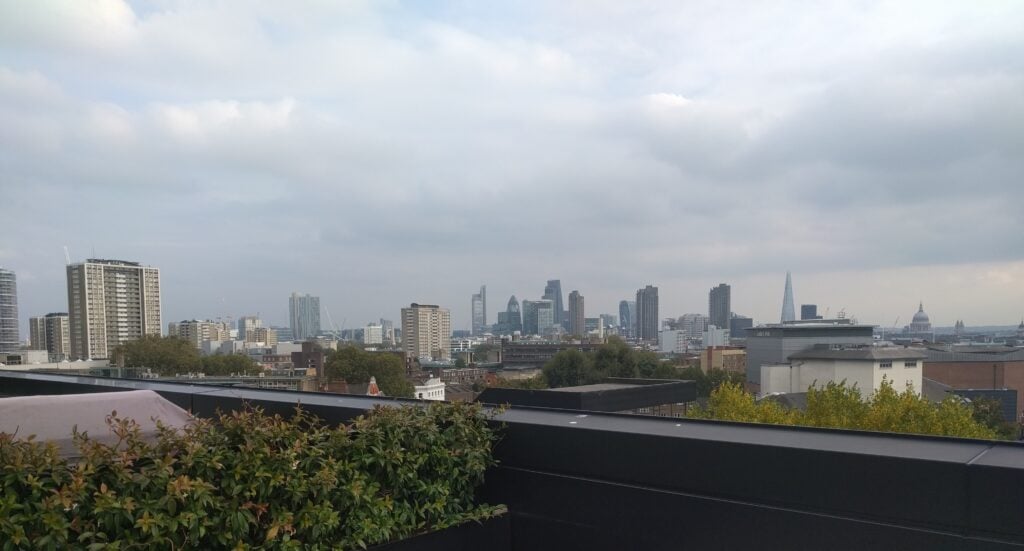
The spectacular view of the London skyline from my office roof

As those of you who know may will recall, I was made redundant from my job as a Scrum Master at Redgate back at the end of May 2016.

Luckily, I wasn’t out of work for too long and since July I’ve been working at a major multinational ecommerce player in the travel and tourism sector (very boring company rules on publicity mean I’m not allowed to name it in blog posts but that doesn’t matter)…

The team I’m in is a backend data team, looking after a number of the main company data sets. As such, our ‘customers’ are the business analysts and finance people who use that data in their reporting.

The wide variety of the sorts of data we handle means that the team is split into sub-teams, handling everything from the basic booking data to feeds of bookings with commission payable on them, and from the data relating to A/B testing on the website to the OLAP cube that’s used by the financial people for reporting up to the CEO.

New challenges

This role has brought a number of new challenges for me so far, which stem just from the nature of the job:

  • Our customers do queries in the databases we provide, so ‘user stories’ are often no more interesting than ‘provide this data in a new column in this table’. Sure, we can explain the business value but there’s no concern about usability and, with the stakeholders in the building, there’s often no interpretation required about what they are actually trying to achieve.
  • Being a publicly-listed company, there are significant overheads from security and auditing concerns. As much as I might like the team to fix their own problems, they don’t have access to a lots of the production systems they deal with in order to enforce separation.
  • Since I joined, it has become a global team, with people in both London and Bellevue (Seattle). In an attempt to avoid siloed knowledge, we have refrained from having some work done in the US and other work in the UK – the work is shared between the two locations, even though this creates a bigger need for communication.
  • Like any team handling backend systems, work is regularly interrupted by critical production issues that can’t wait. This is made more difficult by the fact that we’re handling very big data where processing times are measured in hours if not days. Any delay in fixing a problem can have significant impact on downstream systems and, ultimately, the ability of people to do their jobs.
  • The sub-teams work with a Technical Product Manager, rather than a Product Owner as defined in Scrum. The difference is that the TPM owns not only prioritisation but also provides a lot of detail (sometime too much) on the implementation side.

The first few weeks

As is always recommended, I spent my first few weeks watching how things were working and understanding what I should concentrate on trying to assist with first, resulting in a set of objectives for the first few months, such as:

  • Restarting retrospectives
  • Getting epic-based swimlanes on the Scrum board

    (Individuals had their own work in their own swimlane, which was clearly hindering the notion of working as a team when they each had diverse work to do, and would make migrating towards a Kanban approach in the future problematic)
  • Stopping the useless sprint demo sessions the team was having

    (Stakeholders never attended them and so it was just a ritual for the developers to show each other what they had done in deep technical detail)
  • Supporting the existing initiative to have dashboards showing what data was available and how up-to-date it is

    (The team was working in a very reactive way and often wasn’t aware of problems until our end-users had spotted them.)
  • Improving communication with stakeholders through introducing regular A3 Reporting on high-profile / larger projects

There were two much bigger things on my plate, though, which I’ve spent the bulk of the last few months on: getting the Bellevue team set up and developing the sub-team that’s responsible for the OLAP Cube.

Creating a remote team

This was actually a process that was underway around the time I started. My line manager had just moved to Washington State from London to found the team there, and moving the two Indian developers to the US was just the first step. Between October and December 2016, we had two more developers join in America too.

What fell to me was the practicalities of making this work, when the majority of the developers were still in London, as were all the stakeholders. When it had just been two developers in India, standups could still happen in the morning in London, which was early afternoon in India. The switch to the Seattle area now meant that it was the middle of the night there during the morning in the UK. I didn’t want to move the London standup to the late afternoon, as that would rather defeat the object in my opinion, so we introduced an additional catch-up call at 4pm UK (8am Pacific) to ensure work is kept in sync. To complete the cycle, the team in Washington State leave a message in HipChat at the end of their day, which we can pick up the following morning.

This sort of practicality, and the need for planning and retrospectives to be held at the end of the London day, is easy to resolve, while not ideal. It has certainly led to me having a very odd-shaped day, where I’m relatively free during the middle of the day, and very busy with successions of meetings at the end. The most unexpected issue we’ve faced is a perception among stakeholders that quality has reduced: If things broke overnight London time, they were used to it being resolved by the Indian developers before the stakeholders arrived at 9am UK. That no longer happens, of course.

The biggest issue however, predictably, is communication. As I’ve said, we’re trying to avoid silos by having work shared between people in London and Bellevue, rather than allocating different tasks to each place, but that means getting communication right is incredibly important and complex. Add into the mix the need for the TPM in London to answer the majority of questions, and you’ll understand the difficulties when there’s only 90 minutes of time overlapping between the two offices per day. We’ve already had a couple issues where the Bellevue team-members weren’t quite aligned on the project goals, and a near miss where work was almost duplicated between two people in different places.

Cube team

When I started, the Cube team was in a really bad place. Unlike the rest of the wider team, they’d been pretty much ignored and didn’t really have any process at all – neither Waterfall, nor a form of Agile. They had lots of disjointed, small tasks with no real stories tying them together, and a technical debt backlog kept separately from the product backlog. We’ve had a couple of stories that were aborted during development, because it became clear that the value wasn’t as expected. Above all, however, the people in the team didn’t get along. There was a lead developer, who had the technical skills but struggled with people skills. He was also the original (only) team member. Subsequently, another, more personable, team member had joined and had been made team lead before I started, which naturally caused some tension between him and the original developer. And, most recently, a new junior developer had come into the mix, and was naturally caught in the tensions between the two, which I think was partly a cause of him having little confidence.

What a dream scenario! I believe strongly that people problems can be fixed if caught early enough. I took them through a ‘5 Dysfunctions of a team’ training session over several weeks and we managed to resolve many of the interpersonal conflicts. Simultaneously, I put some gentle pressure on the TPM to improve the roadmap and started setting them up with a basic sprint cadence and teaching them Scrum. This doesn’t come overnight, of course, and they’ve struggled to complete their sprint commitments but by showing them data on what their velocity is, we’re getting nearer.

The plan from now on

The next few months are also going to be very busy. A couple of new major projects is almost certainly going to result in having to adjust the team structure slightly. But beyond that, there are a number of more fundamental things to fix:

  • I want to get the OLAP Cube sub-team working closer with the other sub-teams that they are dependent on. This isn’t helped by them having a different TPM and a different roadmap.
  • I’m introducing a more thorough kickoff process for larger pieces of work, moving from a model where one or two people do a spike and produce reams of spike documentation, to one where the whole team is involved hearing directly from the business what the requirements are.
  • Starting to experiment with introducing BDD as a way of having conversations about the requirements.
  • Set the expectation that Sprints should end with a tangible thing that can be demoed. At the moment, everything is still very waterfall. I see creating regular, tangible, value as the key to getting stakeholders back into demo sessions.
  • Starting to introduce Kanban in the sub-team that has most production issues to deal with.

Exciting times ahead… 

Pain with decimals in Alexa Development

I don’t typically write a blog post like this, but I’ve had an infuriating day messing around writing an Alexa skill, and wanted to explain the issues I’ve faced for anyone else trying to do something similar.

First though, an important note: because of the problem I haven’t submitted the skill to Amazon, so only I can use it at the moment. Don’t bother trying to enable it for your Echo at the moment.

Objective

I wanted to write an Alexa Skill (that’s Alexa-speak for an app) to help other radio amateurs with a very common problem: Given a dipole antenna of a certain length, which you know to work efficiently on a certain frequency, how much do you need to cut or add to make it efficient at another (target) frequency. I therefore wanted to be able to do something like this:

Alexa, ask Dipole Calculator how much I need to cut off my dipole to move it from 14.1 to 14.3MHz

There’s a simple formula to deal with this, which we don’t need to go into here, but the critical point is that moving resonance by a few hundred kHz (that’s to say 0.x MHz) is very common. If you wanted to change frequency by anything larger than that, you’d probably start rebuilding the antenna.

Translating this for Alexa

For those who haven’t dealt with Alexa programming before, you need to know that Alexa commands for custom skills are in a very defined format:

  • ‘Alexa’ is the wake-word, to wake the Amazon Echo up
  • ‘ask Dipole Calculator’ is the Invocation, which tells Alexa which skill to use to interpret the rest of the command
  • the rest of the command is the Utterance, which is the only bit that’s defined in the skill itself

    (For the purposes of completeness, Utterances are linked to an Intent through a file called the Intent Schema, and Intents are effectively functions or methods, which is how Alexa gets stuff done.)

Utterances can contain Slots, which is Alexa’s terminology for a variable. In my sentence above, ‘14.1’ and ‘14.3’ are the slots within the utterance.

The problem

Which is where we get to the problem…

Slots are effectively very strongly-typed. Presumably this is to aid the speech recognition to narrow the number of possibilities for what you are saying. Thus, for each slot in your utterance, you need to define the type for that slot. Built-in examples include AMAZON.NUMBER (an unsigned integer), AMAZON.DATE (a date), AMAZON.DURATION (self-explanatory), etc. You can also define custom enumerations. Note though, that there’s no equivalent of a float or a decimal. This means that I can’t just have two slots (a current and a target frequency): 14.1 wouldn’t be a valid AMAZON.NUMBER, and so it would throw an exception. I obviously can’t realistically create an enumeration of all possible values either.

There used to be a AMAZON.LITERAL type which would return an untyped value, but that’s now deprecated. It’s available in the US English locale for just the next couple of weeks, and those of us in UK English can’t use it at all. Annoyingly, this means that if the speech recognition can’t interpret the value in the slot, it seems there’s no way to find out what the Echo ‘heard’. All you get if a ‘?’, representing the fact that the value couldn’t be matched to something valid for that slot type.

A possible solution?

Trying to think about a way around this, I thought that a good approach might be to create four slots:

[Current integer] point [Current decimal] to [Target integer] point [Target decimal]

In my example above, these four slots would have the values 14, 1, 14 and 3 respectively, all of which are valid AMAZON.NUMBERs.

We’ll come back to this case later, but for now let’s try an easier case, where there’s just one frequency involved: I’m going to calculate the antenna length for a single frequency.

I put this into my Sample Utterances file in AWS Lambda:

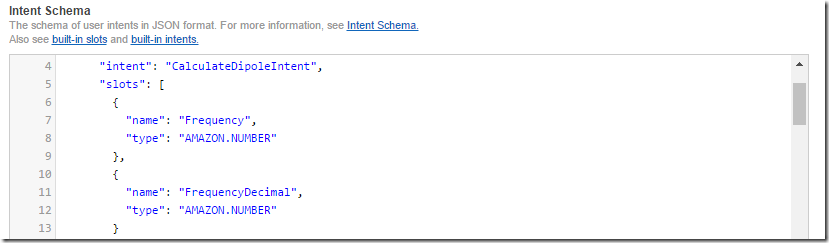
And set the types in the Intent Schema:

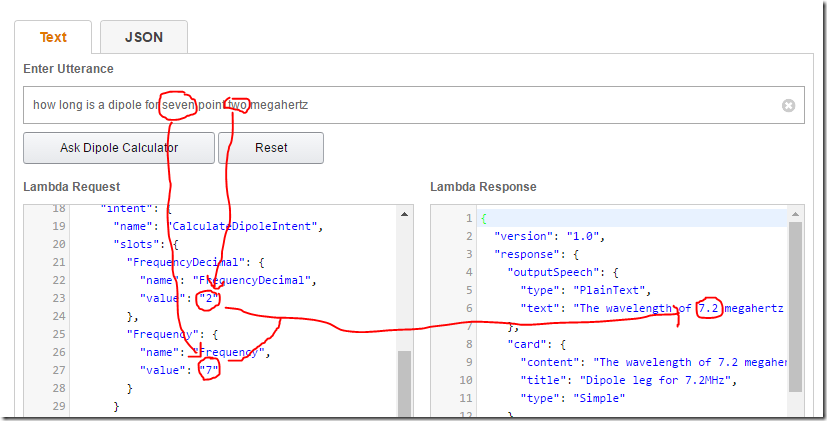
And sure enough it appears to work in the text simulator:

When you try to issue the same command in real-life, however, the number after the decimal place is ‘lost’:

To check what’s going on, I add a console.log() to the function where I run parseFloat(int + “.” + decimal). Checking the logs in AWS CloudWatch reveals that the FrequencyDecimal wasn’t considered a valid value for AMAZON.NUMBER, and so has come back as the infamous ‘?’.

Weird.

Let’s return to the previous, more complex example.

In this case, the decimal place for the first frequency is interpreted correctly, making it evident that my approach should work. But the decimal from the second frequency has again gone missing:

It’s not only me facing this problem, either. There are a number of posts on StackOverflow and also the Amazon Developer Forum (such as this one) without conclusion, other than advising to use literals, which isn’t an option anymore.

Conclusion

  • You can’t have a decimal value type for a slot
  • You can work around this limitation by creating two slots, one for the integer and one for the decimal, and then use parseFloat() to stitch them together
  • But this workaround for some reason won’t work in real life for the last decimal slot in the utterance, even though it appears to be fine in the simulator

Aaarrrggh!

Direction, momentum and oil: Why software development teams are like bikes

I haven’t posted for a while on what I’ve been up to at work and there’s a good reason for that: the team I’ve been working with was pretty dysfunctional twelve months ago and I’ve been spending the last year trying to turn them around. In this post, I’ll describe that journey and why I’ve concluded that software development teams are like bicycles.

Context

I was first asked to spend a couple weeks in April 2015 working with Redgate’s SQL Monitor team as an external observer, finding out why their Project Manager was struggling and why the team was perceived as delivering slowly. In this environment, some of the team were even starting to leave the company…

A bit of background: the SQL Monitor project had been stopped for just over a year after the release of version 4 in January 2014. In the intervening time, no work had happened on the product, and the original team had disbanded. Many had gone off to do other things. In the meantime, revenue had continued to increase and so, in early 2015, the company decided to form a new team to continue that growth. The new ‘team’ (a mix of different people that had been cobbled together, most of whom had no experience on SQL Monitor) would work on one feature in order to get used to the codebase, while the company decided on what the further roadmap looked like. That didn’t sound like a team set up for success.

In my favour was the fact that the team knew they had a problem and so were prepared to work with me to address it. We didn’t have much time, though: the following week, two newly-hired developers were set to join them and we needed to make their introduction as good as possible. So, the usual advice that a Project Manager / Agile Coach should just start by observing the team went out the window. I had to act fast.

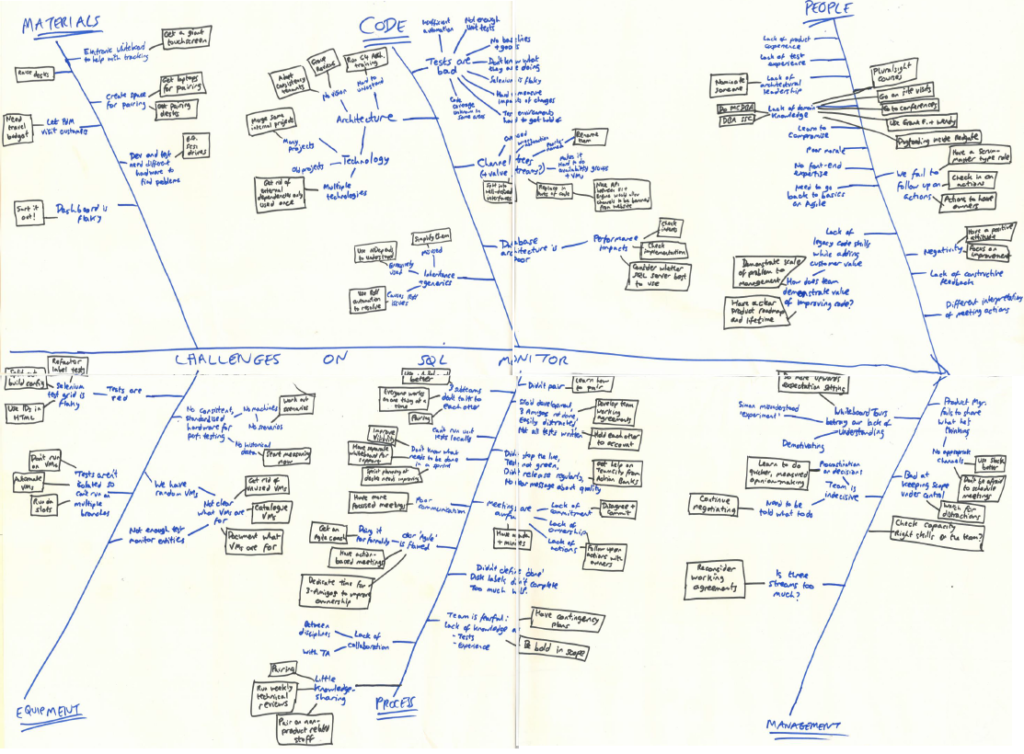
I started by organising a retrospective with the team to investigate their various problems. This was a fairly painful session, which I facilitated, using a fishbone diagram technique:

Fishbone diagram

As expected, there were a number of really fundamental issues here, mainly with the state of the code, but feedback was that it was quite cathartic for the team to see them written down in one place.

To summarize, this was a pretty bad situation: the team had no goals, no deadlines and were struggling to do valuable work. In other words, they had no direction or momentum and the bicycle chain wasn’t even allowing the different parts to work in concert.

Giving a direction

During the same week as that retrospective, I sat down with the Product Manager and got his opinion on commercial direction. It turned out he had a presentation, that had already been presented to other managers, with his idea of a roadmap. It was a well-thought through plan; it’s just that the dev team hadn’t yet seen it. That was another easy fix – I got the Product Manager to give the presentation to the developers and let them challenge the rationale. With this approved, he could then go away to create a 5-year roadmap – rather unusual at Redgate but vital for giving the developers a sense of confidence that the project wasn’t about to be stopped for another year again.

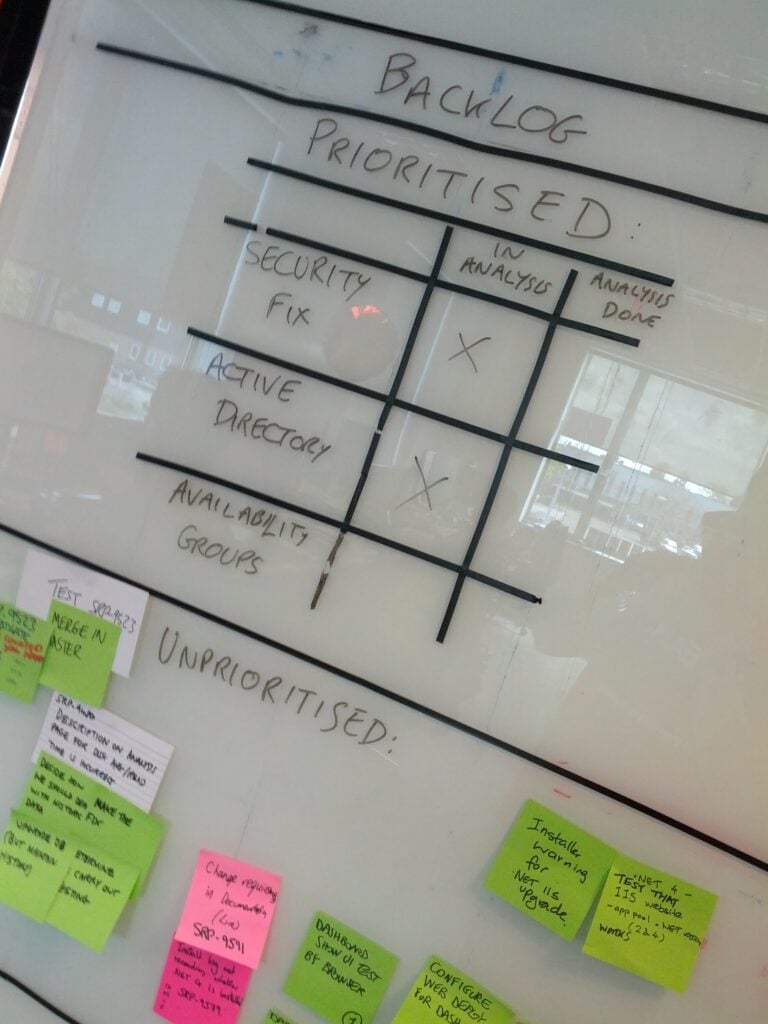
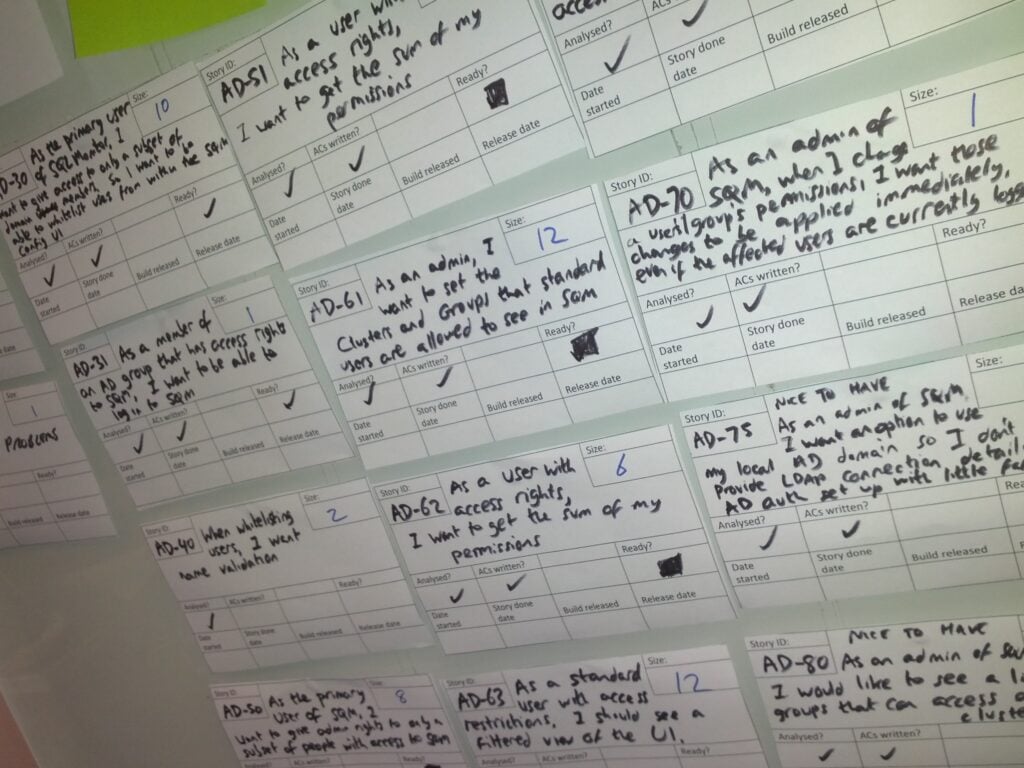
The outcome of the Product Manager’s work was that there were two obvious big features to be done soon – support for Active Directory and support for SQL Server Availability Groups. Both of these were features which competitors had implemented already, and were actively costing us sales. The work felt likely to take a few months, it was mid-April 2015 and there was a big tradeshow, SQL PASS 2015, coming up in October. The way forward seemed clear. I’d re-focus the whole team on those two features and temporarily shut down the other distractions the small team was simultaneously trying to work on (mainly support escalations and code quality improvements). Stopping distractions, and especially support escalations, isn’t easy, and can’t be a long-term solution, but in some cases I’ve found it to be a very useful tool. If you have the right conversations, even the support personnel in the firing line from customers can be brought into the idea.

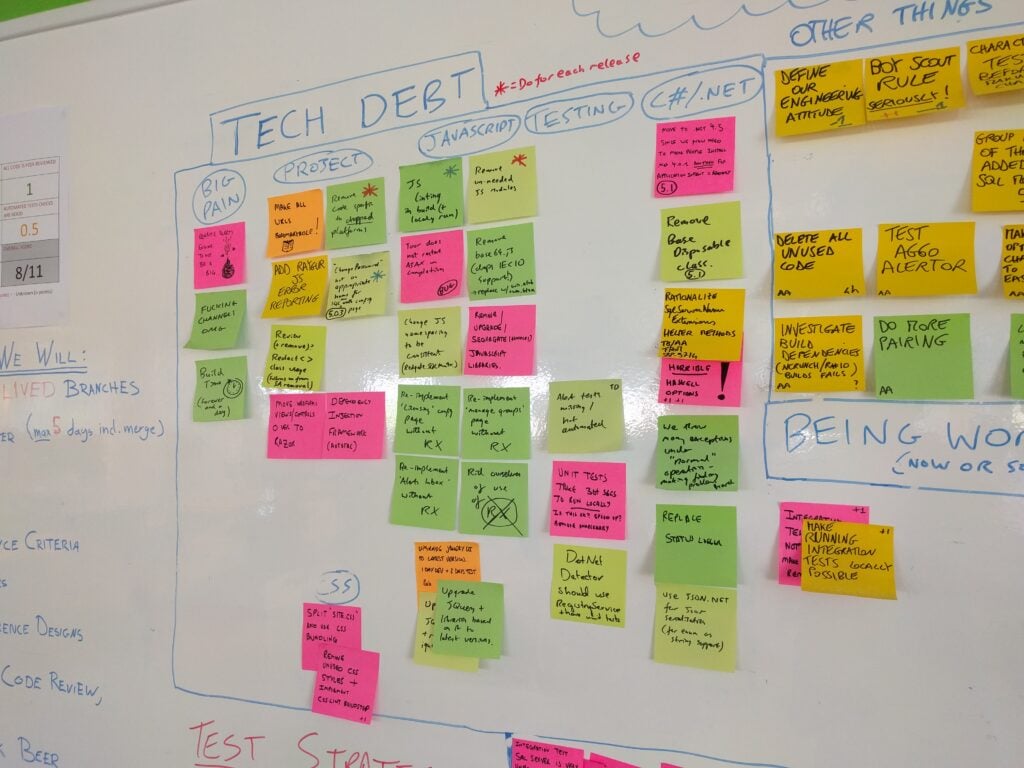
Some people may question the idea of stopping the work to address code quality but the fact is that random pieces of improvement work were being picked up by developers with little planning or sense of what the most important work to do was. Instead, I asked the team to just write down the known technical debt on Post-Its as they were discovered, and stick them to the wall. Together with the actions from the fishbone retrospective, that became a visible reminder of how much debt needed paying back and, in due course, would form a backlog of improvement work to be addressed.

The tech debt wall

Of course, things never are straight-forward. Just as I was starting to get this running, a critical security vulnerability was found in SQL Monitor 4.1. The plan had to be put on hold while SQL Monitor 4.2 was released, and the fix was also backported to previous versions of SQL Monitor.

Explicitly showing what work is prioritised and what is to be done later on

 There – my job was done. The team had a road to follow and, a month or so after joining them, I could leave them in the hands of their normal Project Manager to continue the work…

Speeding up

At the end of July, I returned from a holiday to discover that the existing Project Manager had decided that he no longer felt confident in managing the project. It was a very brave decision to make, and meant that I was catapulted back into the SQL Monitor team again – this time as full-time Project Manager.

My job, though, was fairly obvious by now: keeping the team focused on delivering in time for SQL PASS 2015. This mainly consisted in keeping a fairly tight reign on the team’s approach to sprint planning and capacity planning, at least at first. This ensured also that there was no time available for some of the quality improvement work the team wanted to do, a deliberate choice by me to keep the sense of purpose. Over time, we found a way to handle support escalations once again, and I eventually released the brakes I’d artificially applied to guard against scope creep/changes.

To bring the team back on track, we enforced user stories, estimation and acceptance criteria.

We did it – SQL Monitor 5.0 was released just before the tradeshow, on time and without significant amounts of cutting things from the planned scope.

Through the work on version 5.0 we’d deliberately not released frequently: releasing was hard and required extensive manual testing because the automated tests were unreliable or covered the wrong things. Given the length of time since the last major release, and the team’s lack of knowledge, trying to release regularly could have caused too many derailments.

So, having reached SQL PASS 2015 intact, it was time to set the next challenge for the team: work out how to release frequently. For the major release, the testers had done an extensive risk-based analysis on the major areas of the product they’d need to test. They now used that as a first step to working out what minimal testing would be required. Meanwhile, the developers set to work getting rid of those unreliable automated tests, replacing them where possible, and changing our branching strategy so we’d always be in a position to release.

And that backlog of improvements to the code we needed to make? I got buy-in from the stakeholders so that we could keep our promise. We gave the team two months, without pressure to deliver features, to start working their way through the backlog.

By the start of 2016, we could release every sprint and some of the most egregious code problems were gone. The bike had gained its own momentum.

Providing the oil

Naturally, it hasn’t all been completely plain-sailing. The release notes from the start of 2016 show that there were several bugs and regressions that we introduced as we moved to the new model. For the customers who were affected, we’re sorry. But the fact that the SQL Monitor code, while still far from perfect, is improved, better understood by the team and able to be released quickly means that we’re in a much better position to do some great work in 2016 than we were last year.

By now it should be clear what my role in all this was. The team is pretty much unchanged. The way they work is only slightly different. The developers, testers and designers are still the gears, chain and wheels of the bike. Without them, we wouldn’t have a bike at all. My job was one of lubrication: providing the oil and a bit of direction and momentum to ensure they could go on their journey. It was done through adding brakes and stabilisers where necessary to prevent them from going too far off-course in the early days, then empowering the individuals by giving them the time and space to address the problems they wanted to fix and by protecting them from the mud of management that might have interfered with the way they were working.

Postscript

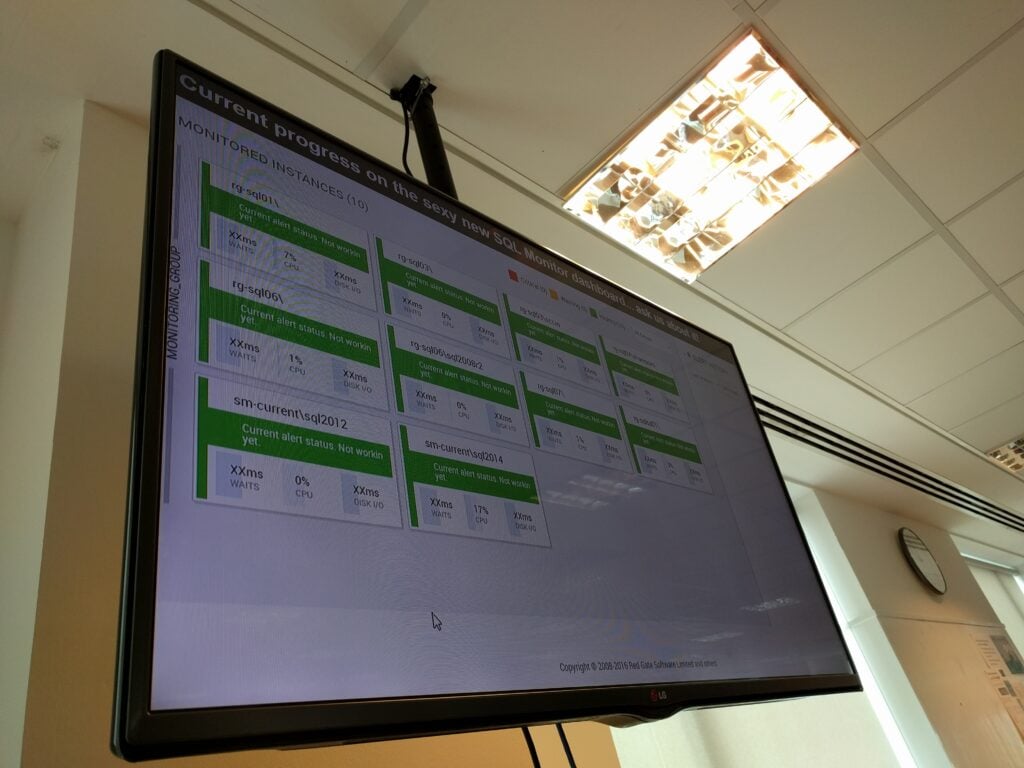
The team’s now working on some really exciting stuff ahead of SQL PASS 2016, including a very impressive new dashboard which is nearing completion.

As for myself, my mentor, Simon Cromarty once told me that the aim of any project manager should be to make themselves redundant: You succeed when the team doesn’t need you any more. So, in a rather perverse way, it should be good news that I stand to be made redundant from Redgate in the coming weeks. If you need someone to help oil your bicycle,  let me know…

Postscript: Reflections on 40 days in Chile

So my trip’s over; what did I learn? Well before I get to that, a little about my trip home:

Coming home

The journey back from Santiago was tiring, of course, but quite pleasant. We flew in EC-LEU, a much more modern A346 than the one we went out on. It had in-seat touchscreen entertainment, and even WiFi and a GSM picocell (though I didn’t investigate the cost of these). On the other hand, I didn’t get much sleep. Iberia had a slightly odd approach to the in-flight service, too: in addition to the basic evening meal (pasta) shortly after take off at around 4pm CLST, and a light breakfast just before landing at 06:30 CET, there was a half-salami sandwich at midnight CET. My body-clock really wasn’t sure what meal that was supposed to be! We were also about an hour late taking off from Santiago as the luggage belt had apparently broken and so we had to wait for two containers of luggage to be delivered to us. At least the plane did wait, though, and we were still away before the strike started. We arrived more or less on time too, thanks to a decent tailwind over the Atlantic, but that did also make the flight a little bumpy, particularly as we crossed the equatorial zone.

The flight back from Madrid in G-BZHC was rather less comfortable. I didn’t know BA still had some really ancient B763s in their fleet but apparently so. It really was quite old. We were also twenty minutes late leaving thanks to an ATC strike in France that had slightly reduced capacity over their airspace, but again, a decent tailwind (which has also been keeping Western Europe very mild for December) meant that we landed about on schedule. I was lucky too: not only did my bag survive, but it was one of the first off too.

There was just one amusing thing to describe from the flight: my Bencher morse code key (which was in my hand-luggage as it’s a little fragile) looks similar to a battery on an X-Ray machine and so throughout my travels it had raised eyebrows in security, but no problems. In Santiago, the same was true again, but this time the X-Ray machine worker was so interested when I showed it to him that he took his eyes off the screen and let the conveyor belt run everyone else’s bags through unchecked, while he and I had a discussion about how it worked!

What I learnt

And so now, here’s the what I learnt about life in Chile. Hopefully this will be useful to anyone else going there:

Money

Credit cards, as I had read before I went, are very widely accepted, and there isn’t any of the ‘major credit cards’ distinction we have in the UK. Anywhere that will take Visa/Mastercard will also take AmEx and Diner’s Club. You are often asked whether it’s a Credit Card (if the merchant doesn’t ask and presses the button for the national RedCompra debit card system, the transaction will be refused) and sometimes you’ll be asked which currency you want to pay in (see below). European chips aren’t generally recognised by the machines and need swiping. Contactless payment, which I only found in one supermarket, doesn’t work with a UK card. When you use a credit card, you need to give your passport number in addition to signing. I’d suggest memorising the number to save time at checkouts as getting passports out can be frustrating. You’re sometimes also asked whether you want the transaction to be sin cuota or con cuota. It seems that Chilean credit card terminals can separate transactions into multiple payments over time, presumably so you can take advantage of interest-free installments offered by the merchant, rather than by the card company. Anyway, I always answered sin cuota, and everything worked fine.

ATMs are also plentiful. I found that Banco Estado machines didn’t work with Visa Debit cards, but both Santander and BBVA did. Watch out though, as Santander add a 5000 CLP (£5) fee to the transaction in addition to any fees charged by Visa / your bank. BBVA don’t charge this fee. When you use a cash machine, there’s an odd question you have to answer, about whether the card is for a Credit Card / Savings Account / Checking Account / Current Account. I found that Checking Account worked for UK current accounts. Machines that had the Current Account option didn’t always approve the transaction.

The one mistake I made was taking US Dollar-denominated AmEx traveller’s cheques (for the additional security these provide). I only found a couple places in Santiago that would exchange these; most places won’t touch them, and where they are exchanged the rates are very disadvantageous. (E.g. 600 CLP = $1 for buying traveller’s cheques, when the same place would buy dollar cash for 706 CLP. I even found one place offering 500 CLP = $1).

If you’re booking hotels, you’ll almost certainly have come across the strange VAT rule: to encourage tourism, hotel stays for foreign tourists are exempt the 19% VAT charge. In theory, to show you’re a foreign tourist, you have to pay in US Dollars (hence why you may be asked what currency to pay in), they have to take a copy of your passport and immigration receipt, and you have to declare that you are staying less than sixty days. That’s the theory, but not all places adhere to these rules in practice. Some places will allow you to pay in Peso cash but will make out the invoice in Dollars, for example. Only one hotel I stayed at didn’t know how to deal with a foreigner under this VAT rule. If that happens, you need to ask for a Factura de Exportación (Export Invoice), which will prompt them to handle it correctly, even if you think that the it would be hard to export a hotel stay! Incidentally, I found that campsites worked on a Peso cash-only (no cards) basis, with no need to show passports. I didn’t get receipts from the campsites either. Hostels (as opposed to hotels) were also generally cash-only but did take passport details and issue Export Invoices.

Driving

This section is, like the rest of this post, based on my experience only. I’m not an expert on Chilean driving law, so you should check what I’ve written here.

I didn’t drive anywhere particularly busy, and certainly not in Santiago, but driving was quite easy. Ruta 5, the Panamerican Highway, is very good quality and is mainly dual carriageway (it goes to single carriageway on Chiloé). Ruta 5 has a general speed-limit of 120 kph, which is generally followed by most drivers.

The main thing to watch out for on Ruta 5 is that, like all other roads in the country, it has bus-stops with pedestrian crossings over it: not what you’d expect on a fast motorway. These are signposted as 30kph zones (see below on speed limits) but everyone ignores that unless a bus is around, as to do 30kph on such a fast road would be dangerous.

Other major roads, where the speed-limit is 100 kph, are of variable quality. Some are good; others may be little more than unsurfaced dirt tracks. Maps do show which roads are surfaced and which aren’t but I found they were often out-of-date.

I soon learnt that the main thing is to watch the line of the driver in front of you and to follow their tyres. Very deep potholes are numerous, even on major roads. Additionally, in roadwork areas, it seems common for the roadworkers just to remove the road surface without warning, or with just a Peligro (‘Danger’) sign. One minute you’re on nice surfaced road and then there may be a gravel/stone surface, which may only be a metre long, or may go on for miles. Bridges are another thing to watch for: in the UK we take it for granted that the road surface will match the bridge. Not so in Chile: if the road approaching the bridge has adverse camber and the bridge is laid completely flat, there will be a massive ledge on one side of the road where you join the bridge. Again, follow the car in front. If it suddenly switches to driving on the left on an approach to a bridge, it’s probably to avoid this!

Built-up areas are more difficult. The speed-limit is 60kph but again this is generally ignored. The 60kph zone may not be explicitly signed either: a Zona Urbana sign at the start of the built-up area also counts as a 60kph sign. Most towns are designed on the US block system with one-way streets. In places, my Tom-Tom satnav had the one-way system completely the wrong way around, which didn’t help. In common with the American layout, crossings are generally four-way stops but there may be a prioritisation implied if some of the approaches have Pare (Stop) signs, and others don’t. An interesting Chilean feature of four-way stops is their habit of putting pedestrian crossings, across them. This means that if you follow the paintwork on the road, and stop at the stop line before the crossing, you can’t see the other roads at the junction. You have to stop on the crossing to have visibility. And then, when you turn, expect there to be a pedestrian crossing on the road you are turning into. You may need to stop in the middle of the junction until they have crossed.

Some towns have a lot of traffic lights. Unlike America, where there are traffic lights, turning right on a red light isn’t generally legal unless explicitly signed. If there are pedestrian lights at four-way stops, it will usually be green for pedestrians at the same time as it is green for cars on the road that’s parallel to the crossing, so again, if you’re turning left or right, you need to expect a pedestrian to be crossing the road you’re turning into, even if the lights are green. I only found a couple roundabouts in the whole country.

In towns, lanes were a particular pain. Often they just aren’t painted, or where there are two lanes painted, taxi and bus drivers will try to squeeze past, making a third lane! It wasn’t uncommon for lanes to change within a few hundred metres either: for example a two-lane road where the left-hand lane is for left-turns only approaching one junction and then the right lane is for right-turns only approaching the next junction, meaning cars going straight on have to do a slalom.

Speed limits, as I’ve said, are often ignored, except that people don’t exceed the 120 kph maximum on Ruta 5. This is partly, I think, due to how difficult it is to tell what the speed limit is in some places. I mentioned the example of a 30 kph zone for a pedestrian crossing across a fast motorway above. That 30 kph zone will never be signed as being cancelled. So, as you drive, you find yourself having to guess what the hazard is that has caused the reduction, so you know when to speed up once you’re past it! Equally, on Ruta 5, I often found that there would often be a 50kph or 40kph sign just before an exit. It turned out that this is because of a sharp bend on the slip-road at that exit, and so traffic continuing on the road didn’t need to slow down anyway. Having said all that, I did see a few police speed traps with radar guns on both Ruta 5 and also on Ruta 64 (the road to Valparaíso). I generally just did something slightly slower than the cars around me if I saw one of these and didn’t know what the current speed limit was!

Security

Chile felt a remarkably safe country, and all the people I met were incredibly friendly. Despite the television news which reported an armed robbery, shooting or carjacking almost every day, only one or twice did I start to feel a little uncomfortable. The police (Carabineros) are very present patrolling in all built-up areas and I got the sense they were well respected. People would have their photos taken with them and chat to them, and indeed their motto is ‘Un amigo siempre’.


So, it was a good trip. Don’t forget: you can read the full set of blog posts I wrote from each place I visited, and my photos are all on Flickr.

13th & 15th December: Santiago

Getting here

I flew from Punta Arenas to Santiago in CC-BEH, another of LAN’s Airbus A321s, but this one fitted with rather more seats than the flights to/from Iquique and Temuco, leading to much reduced leg room for the 3 hour flight. It looked quite a new aircraft, and checking since the flight, I discovered that it had its maiden scheduled flight on 26th November, so it was only a couple of weeks old.

The only problem was that my bag was damaged during the flight, and arrived open with contents exposed. Fortunately, I haven’t yet identified anything significant as missing, but it did mean I had to buy safety pins and duct tape in Santiago to ensure the bag survives the journey back to London later this week!

Estación Central District

I spent Sunday having a quiet day around the Estación Central district, just to the west of the main centre of Santiago. This is also the area nearest my hotel, so it’s easy to reach.

Parque Quinta Normal

The Parque Quinta Normal is a wonderful surprise; a 36-hectare nineteeth century formal park, in the middle of the urban environment. Entry is free, although it was slightly disturbing that the security guards at all the park’s entrances were wearing bulletproof vests. I certainly didn’t feel unsafe, though, and I got the sense this is just part of standard-issue uniform, rather than a response to a specific threat.

The park not only contains paths winding through trees and flowerbeds, but also fountains, a boating lake, tennis courts, football pitch, and plenty of people wondering around selling ice-creams out of large polystyrene boxes with wheels on. I wonder how cool the ice creams can stay without refrigeration; I didn’t try!

Museo Ferroviario

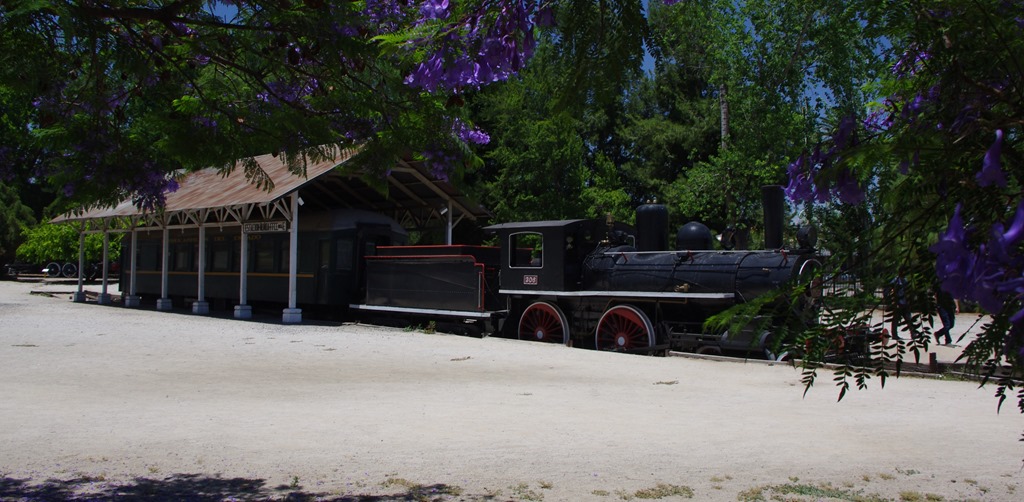
Somewhat bizarrely (but there’s a certain romance to it), a corner of the Parque Quinta Normal is the home of the National Steam Train Museum. For a very modest entrance fee of 800 CLP (80p), you can see a number of steam engines that ran on Chile’s mainline services from the 1850s until the 1970s. The majority of these trains were American-built, but a couple came from the UK.

Museo de la Memoria y los Derechos Humanos

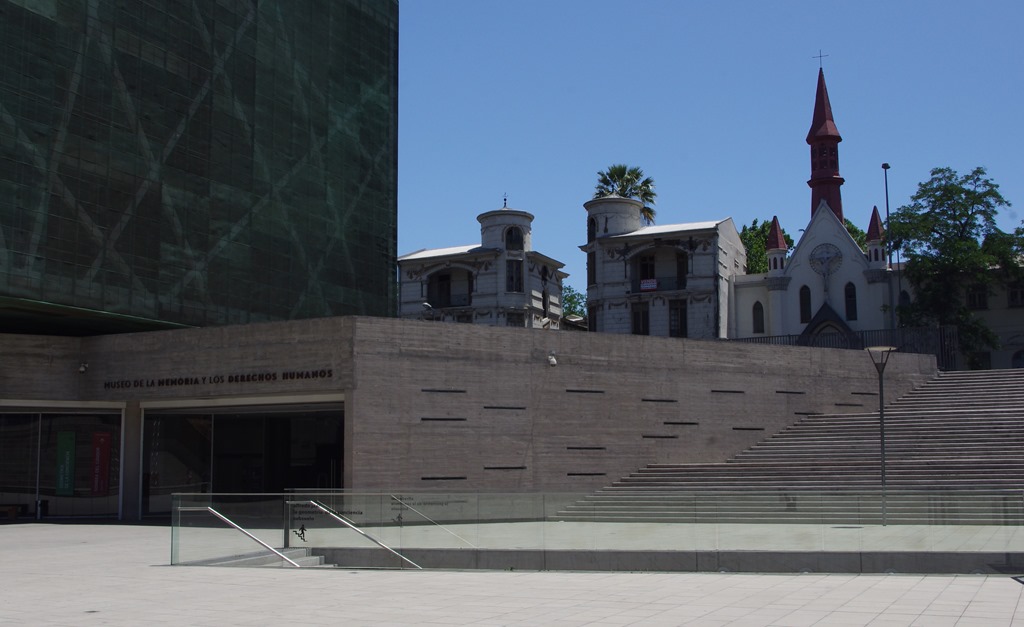
Opposite the Parque Quinta Normal is the Museum of Memory and Human Rights. This is a really well-done exhibition centre that serves both as a museum telling the history of the rise and fall of the Pinochet Regime, and also as a memorial to The Disappeared, with some of their stories and horrific details of the types of torture that were in practice at the time. In the basement is the document centre, which houses the regime’s archives.

Understandably, in an effort to maintain the sobriety of the place, photography inside the museum is banned. Entrance is free but you are encouraged to give a voluntary donation.

Central District

On Tuesday, my last day in Chile, I went to the central part of Santiago, where there are a lot of sights very close to each other.

La Moneda

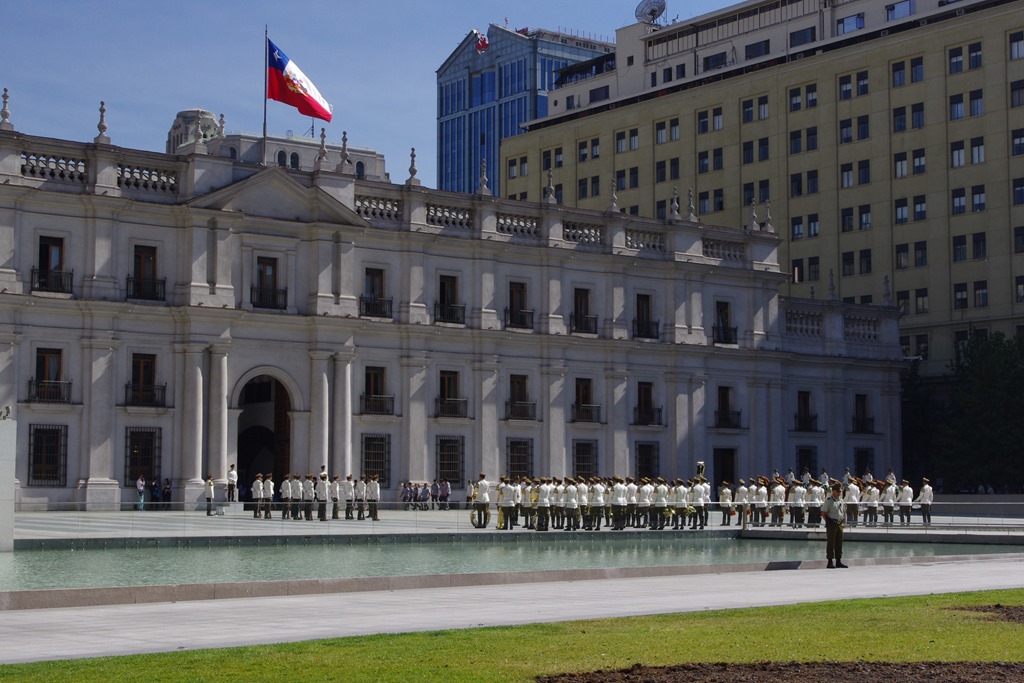
My first stop was at La Moneda, the Presidential Palace. I made a point of getting there just before 10am so I could see the changing of the guard. This is possibly an even more grand event than the one at Buckingham Palace as it involves stopping the traffic on one of the main dual-carriageways through the city so that the band and horse-mounted guards can cross it. It was quite a sight.

Plaza de Armas

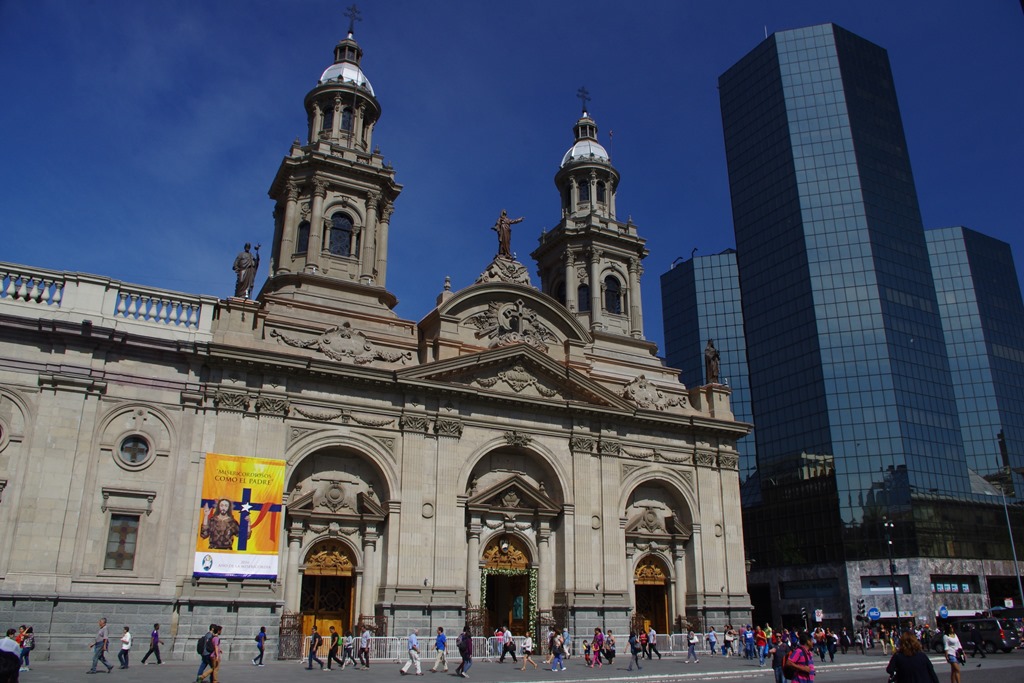
After La Moneda, I went a few blocks north to the Plaza de Armas. This is a lovely open space surrounded by, amongst other things, the Cathedral (below) and Central Post Office (now a postal museum). The Plaza was quite busy but the police were keeping good order, patrolling the square on Segways! Within a couple streets are also the ex-Congress building (which Pinochet moved to Valparaíso just before handing over the the democratic government), and the very interesting Museum of Pre-Columbus Art. This museum has a relatively small collection of Chilean art from the various native populations in the basement, and upstairs, a larger collection from the rest of South America (principally Peru and Mexico). One thing I learnt is that some of the pre-Inca people in modern northern Chile were practising mummification of their dead as early as 6000 B.C., well before the Egyptians discovered the technique.

Santiago Metropolitan Park

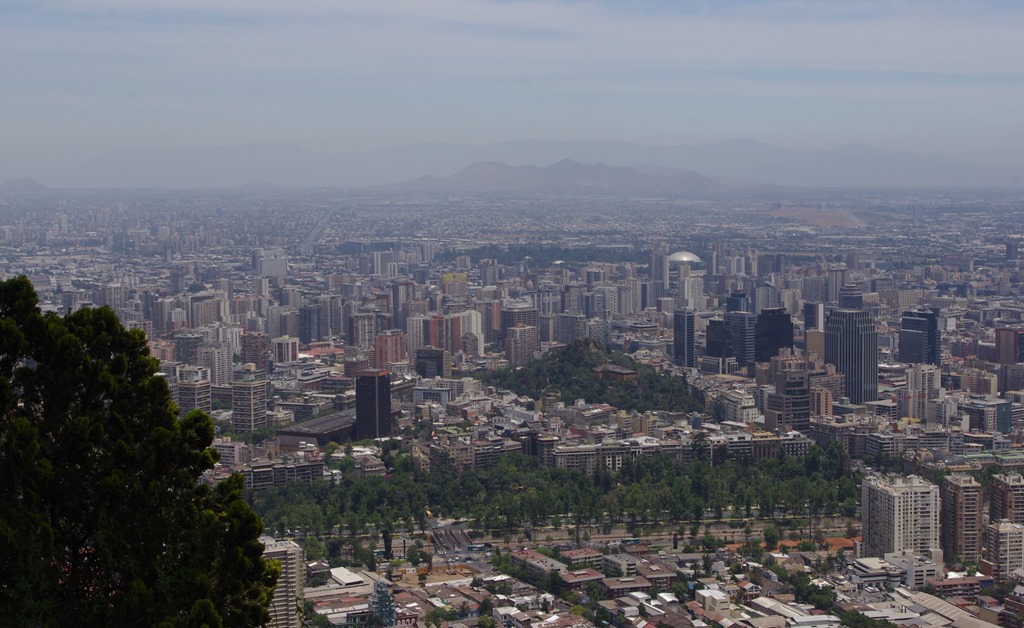
After lunch, I headed to the northern part of the city, to visit the metropolitan park, which is on San Cristóbal hill, about 300m above the rest of the city. You reach the park via a 1920s funicular railway, which costs just 2000 CLP (£2) for a return ticket, and which departs every 15 minutes. The funicular usually stops halfway up the hill, where the city zoo is situated, but that stop is currently closed for renovation (access to the zoo – which I didn’t visit – is by walking up only). On arrival at the top, we were serenaded by a busker playing a mash-up of Silent Night, Jingle Bells and Sloop John B simultaneously on guitar and panpipes. From the park there are some spectacular views over the city, and it’s also the site of the statue of the Virgin Mary, which overlooks the city, much as the more famous Christ the Redeemer statue looks over Rio da Janiero.

Unfortunately, the cable car which runs from the summit by the Virgin to the other end of the hill was also closed for renovation, so there was a little less to see than I was hoping, but it was still a brilliant sight, and well worth the trip.

It was getting quite hot by now (32C), so I tried some Mote con Huesillo. This is a ‘drink’ I’d seen advertised throughout my travels in Chile, but I’d never yet tried. I put ‘drink’ in quotes as it would be impossible to consume without a spoon, since it contains wheat and whole peaches. It’s quite nice and refreshing, but also very sweet.

To conclude my day, I took the Santiago underground back to my hotel. This is incredibly easy. A flat-price single ticket is 660 CLP (66p). The only thing that confused me is that, because it’s a flat-fare system, tickets are only checked on entry to the underground. You don’t get the ticket back from the barrier, and you don’t have to provide it again to get out at your chosen exit station.


And that’s just about it. Tomorrow, I fly back to London (and I’ve been very lucky, too: I miss a strike by aviation workers by a day!). It’s been a great five-and-a-half weeks in Chile; thanks once again to Redgate for giving me the time to do the trip. Once I’m back, there’ll be one final post in this series, covering some of the things I’ve discovered over nearly 40 days’ travelling through the country. In the meantime, a reminder that all my photos (most of which haven’t been included in this blog) are on Flickr, and you can read all the posts in this series. Finally, there’s a map of where I’ve been on my Chile landing page.

14th December: Valparaíso

I think I first heard of Valparaiso, bizarrely, in a CD of French sea-shanties I was once given. I never thought I’d get to go there:

Puis nous irons à Valparaiso,
«Haul away», hé houlà-t’chalez
Où d’autres laisseront leurs os,
«Haul» matelot, hé ho hisse et ho !

 Getting there

Valparaíso is easy to reach as a day-trip from Santiago, which is what I did. The Tur-Bus bus service runs very regularly (it seemed to be every 15 minutes at peak times) from Santiago’s central bus station, which handily is just next to my hotel. The 2-hour journey cost me 2000 CLP (£2) having bought an advance ticket.

There’s a good quality motorway, Ruta 68, linking Santiago to the port city. Once you’re out of the capital, the landscape is quite reminiscent of parts of northern Spain – hills that have been parched by the sun (it was in the mid-20s C today, with a very strong sun), other than a few hardy shrubs. Route 68 itself runs mainly in a more fertile valley with vineyards and the occasional field of maize to the sides.

Valparaíso

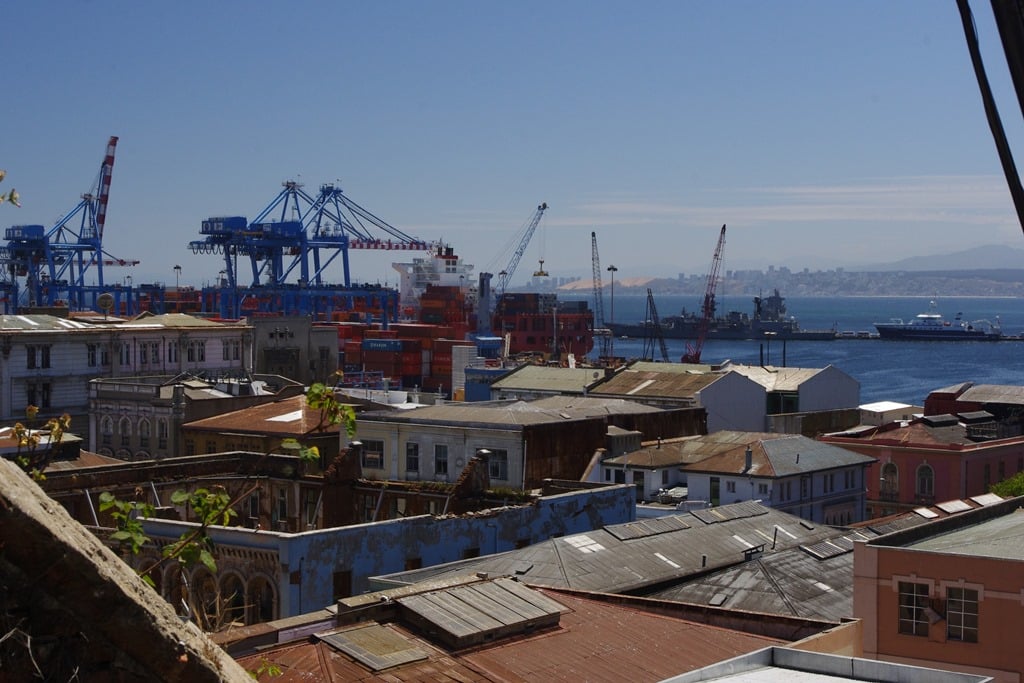
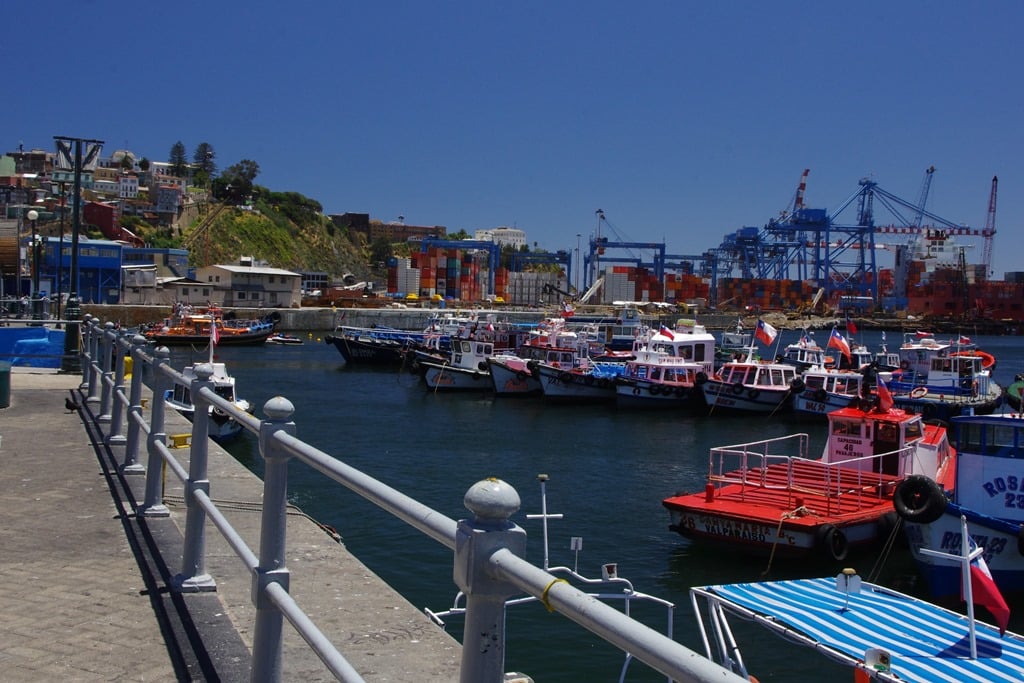
The city of ‘Valpa’ (as it’s known locally) is a major cargo port, and – despite it taking several pages in my guidebook there didn’t seem to be much more to it than that. Most of the tourist sites are within a small area near the port. I’m glad I was only here on a day-trip, and not staying longer, as I think I would have run out of things to do. As it was, I had seen most of the things I wanted to within a couple of hours.

The tourist areas themselves are pretty enough but turn a corner and its easy to find once-opulent buildings in a severe state of decay very close by. Part of this will undoubtedly be due to earthquakes, of which Valparaíso has suffered a large number of the years, but I also got a sense that some of it was just neglect, or a lack of money. This can easily be seen in the picture above.

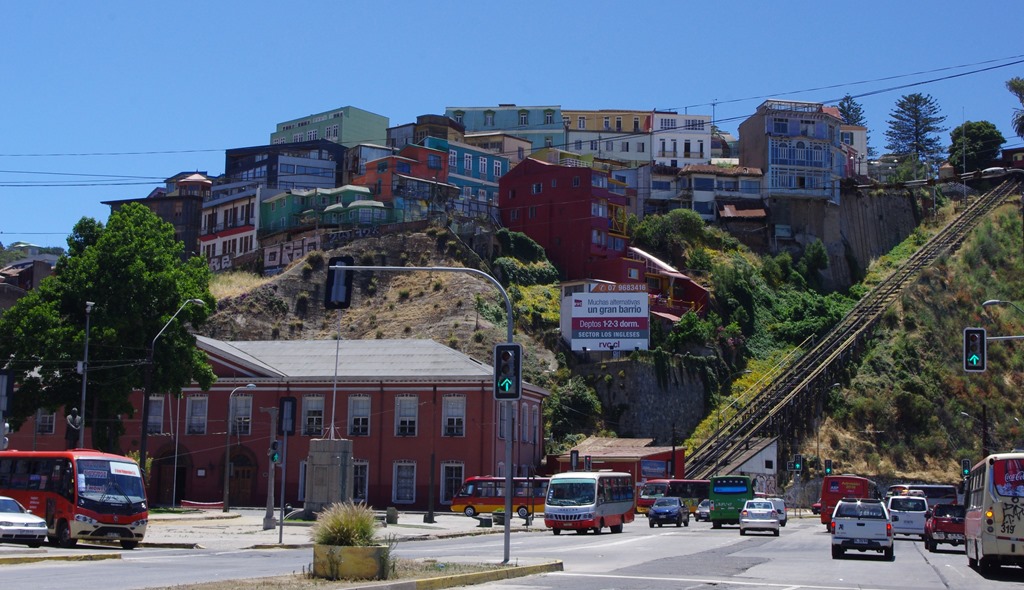
The thing for which Valparaíso is most famous, of course, is that it’s built on a steep cliff-face leading down to the sea, with nineteeth-century funiculars linking the town together. These are somewhat rickety, by all accounts – I didn’t get to go on one personally – but I did claim 161 steep steps to take the first photograph in this post!

 German influence

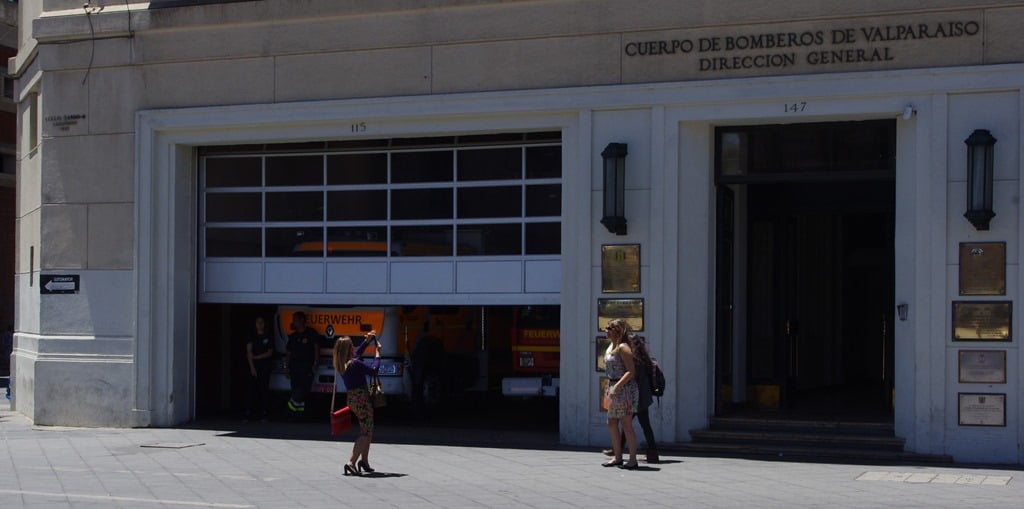
You may remember from my writings on Frutillar about the extent of the German influence on Chile. While I was there, I thought I’d seen a fire-engine that was marked ‘Feuerwehr’. I later learnt this was in recognition of the fact that it was German immigrants who founded the first voluntary fire brigades in the country. It seems this is done in Valparaíso, too:

Evening meal

One of the unique features of the Spanish-speaking world, with which you may not be familiar, is the apparently acceptable habit of random street sellers interrupting your meal in restaurants to try to sell you things. (This tends to be restricted to less-touristy restaurants, it’s mainly in cheaper places.) In my experience, this tends to be limited to flower sellers in Spain, but here in Chile it can be any old ‘tat’.

I must tell you about my experience this evening, once I’d returned to Santiago: I’d gone to a pizza restaurant, which served the oddest pizza I’ve had. It was about 6 inches diameter, with about a 1-inch deep bread base, and about another inch of topping piled on top, all served on a plate that was exactly the same diameter as the pizza itself. You’d have thought a pizza restaurant would have established long ago that melted cheese needs space to spread. It was impossible to avoid it going all over the table as I tried to cut through the massive crust. Anyway, while I was doing battle with this beast, a lady appeared and dumped a load of oversized bank notes on my table, and then on everyone else’s tables. Once she’d been around everyone, she came around again to collect them all up. No-one made an attempt to buy them. I guess, as in the USA, fake bank notes are legal to produce as long as they are oversized, so they can be used for film and television.

Within five minutes, an older man interrupted me with a large bag full of various top-branded perfumes. I suspect they weren’t all genuine. When I ignored him, he moved on to another table. While he was still going around other customers, another boy, probably about 14 years old, came in with the strangest item yet: it was essentially a plastic test-tube, filled with water, with a red plastic heart floating in it. Again, he went to each table and put one of these on the table, then immediately went around collecting them up. One person in the pizzeria did get his wallet out for this odd ‘gift’. I have no idea why, and I decided not to stay any longer. I paid the bill and made a swift exit before anyone came in with anything else.

My WordPress Blog